
Adrian Stoian
Lead Product Designer
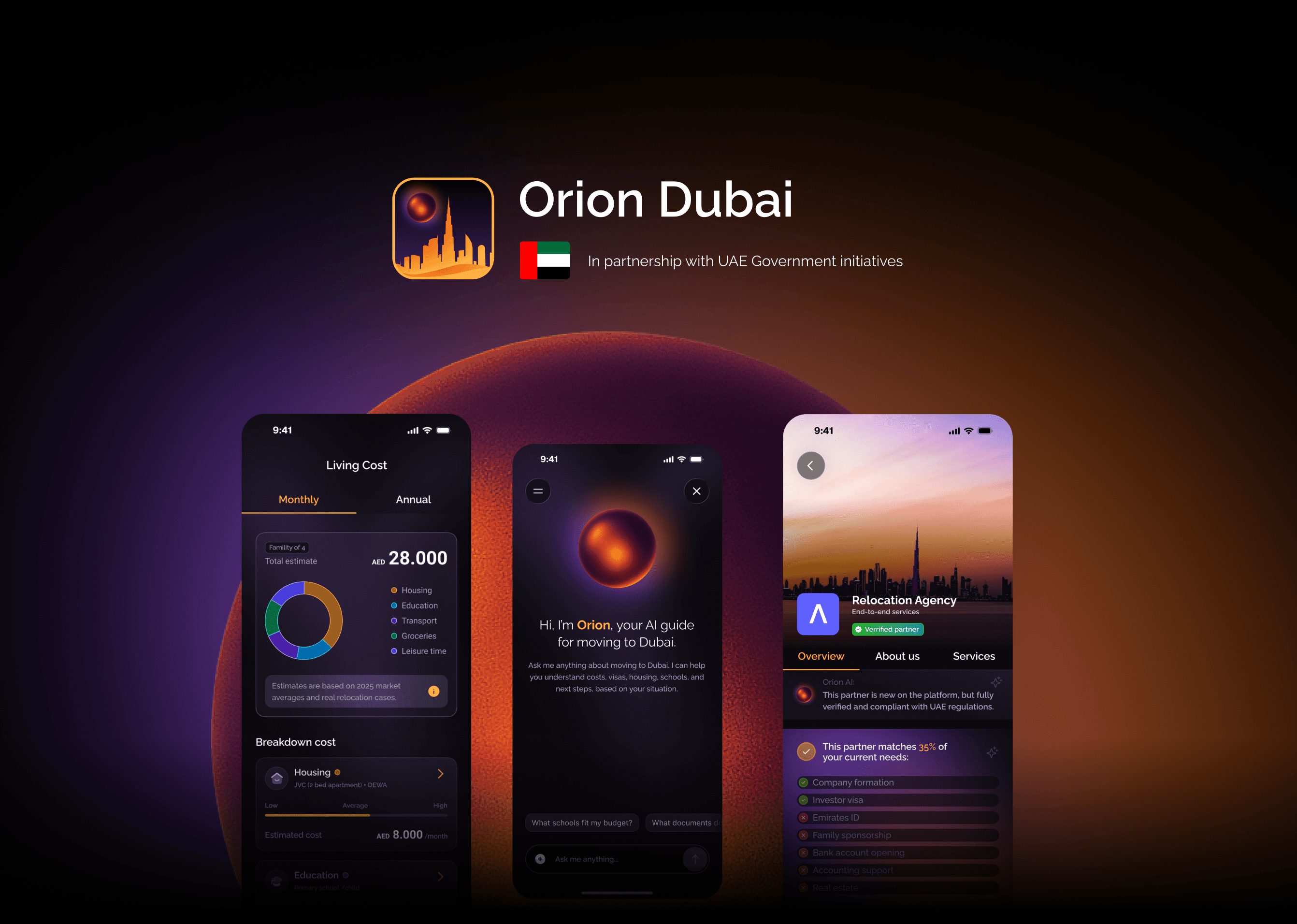
Intelligent AI Relocation Mobile App

The Context
Dubai Is Growing. The Process Isn’t.
Dubai 2040 Urban Master Plan
3.2 mil
5.8 mil
Dubai’s 2040 Urban Master Plan aims to grow the population from 3.2 million to 5.8 million residents.
That means hundreds of thousands of relocations in the next 14 years.
But while the city evolves strategically, the relocation process remains fragmented, opaque and intimidating. Relocation is not a single action.
It is a chain of dependent, bureaucratic procedures involving:
Government entities
Free zones
Banks
Medical centers
Relocation agencies
Legal intermediaries
The system exists. But it is not structured for the individual.

My role
What I did?
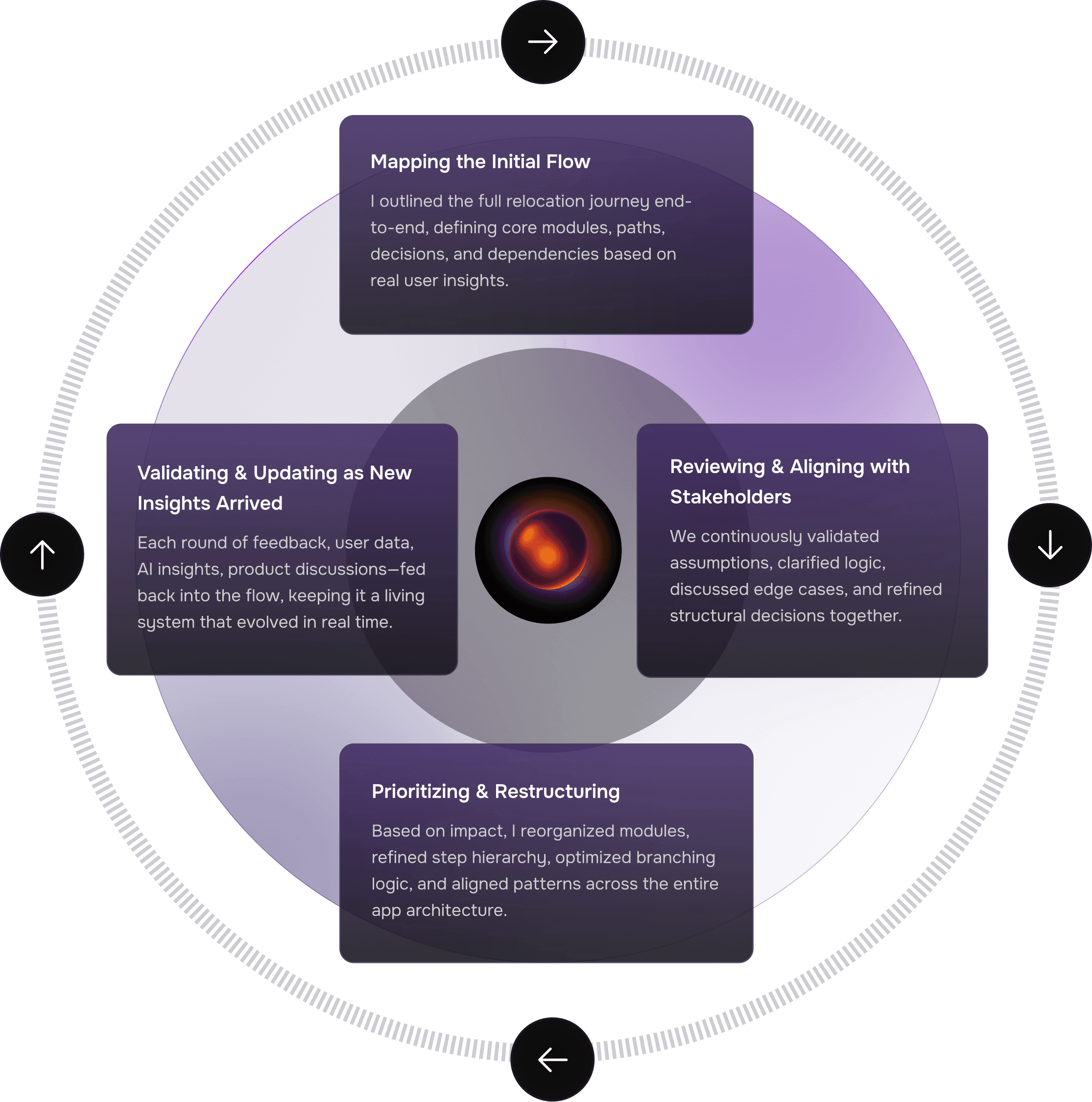
As the Lead Product Designer, I owned the complete design direction of the Orion platform, from early UX exploration to final UI execution. I defined the vision, the architecture, and the end-to-end user experience for both residents relocating to Dubai and partners managing clients.


Product strategy & UX direction for the entire platform
User research & data-driven insights (AI research agent, interviews, sentiment analysis)
Deep understanding of AI behavior & LLM orchestration, designing how agents interact with user inputs, documents, and flows
UI exploration & visual language definition
(30+ iterations)
End-to-end UX/UI design for all modules
Partner workspace architecture and communication flows
AI integration (contextual assistant, insights, document validation, recommendations)
Designing the full platform architecture (flows, phases, steps, navigation)
Hybrid onboarding systems (Wizard + LLM-based conversational onboarding)
Design System foundations (patterns, components, tokens, behaviors)
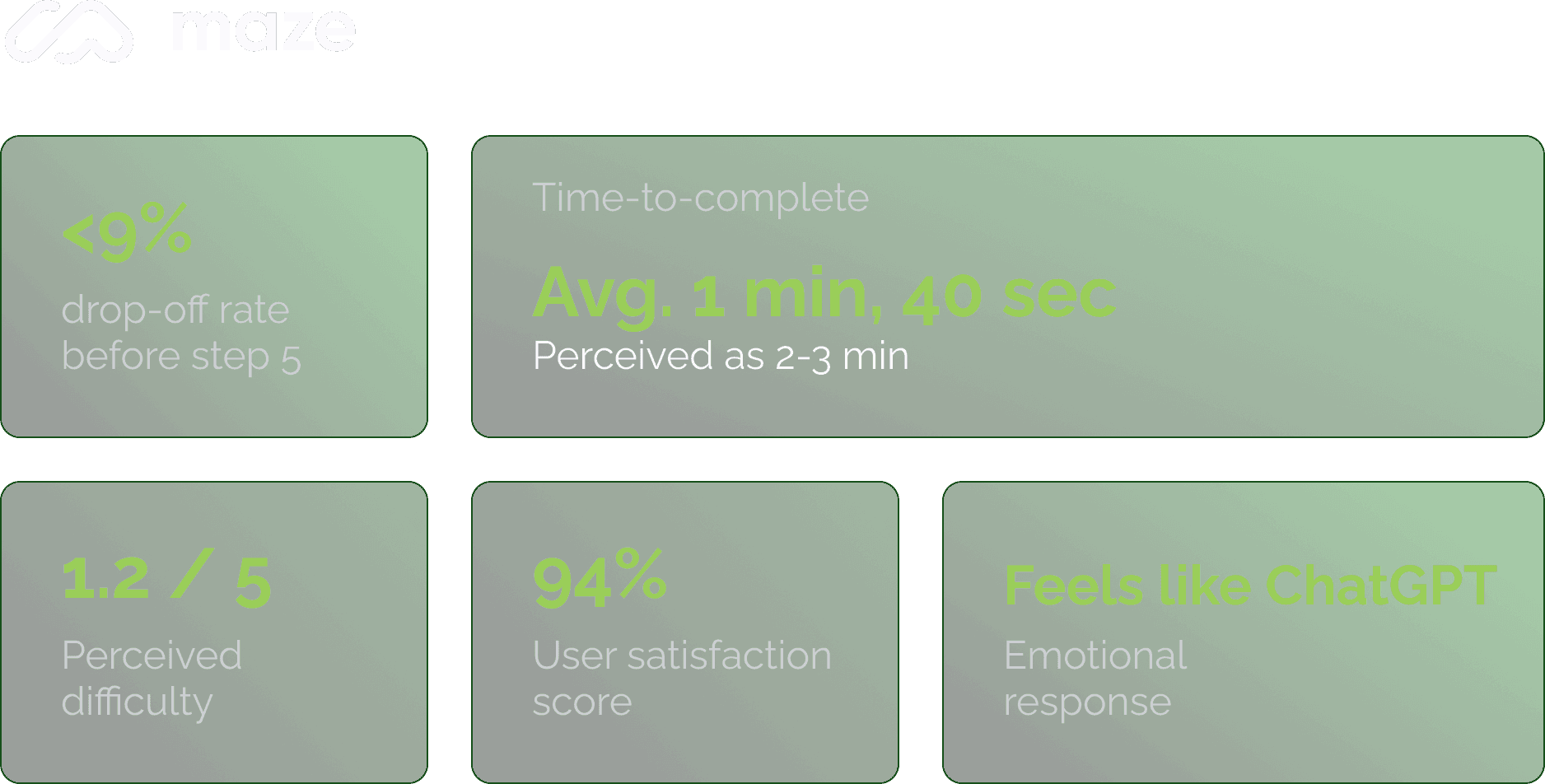
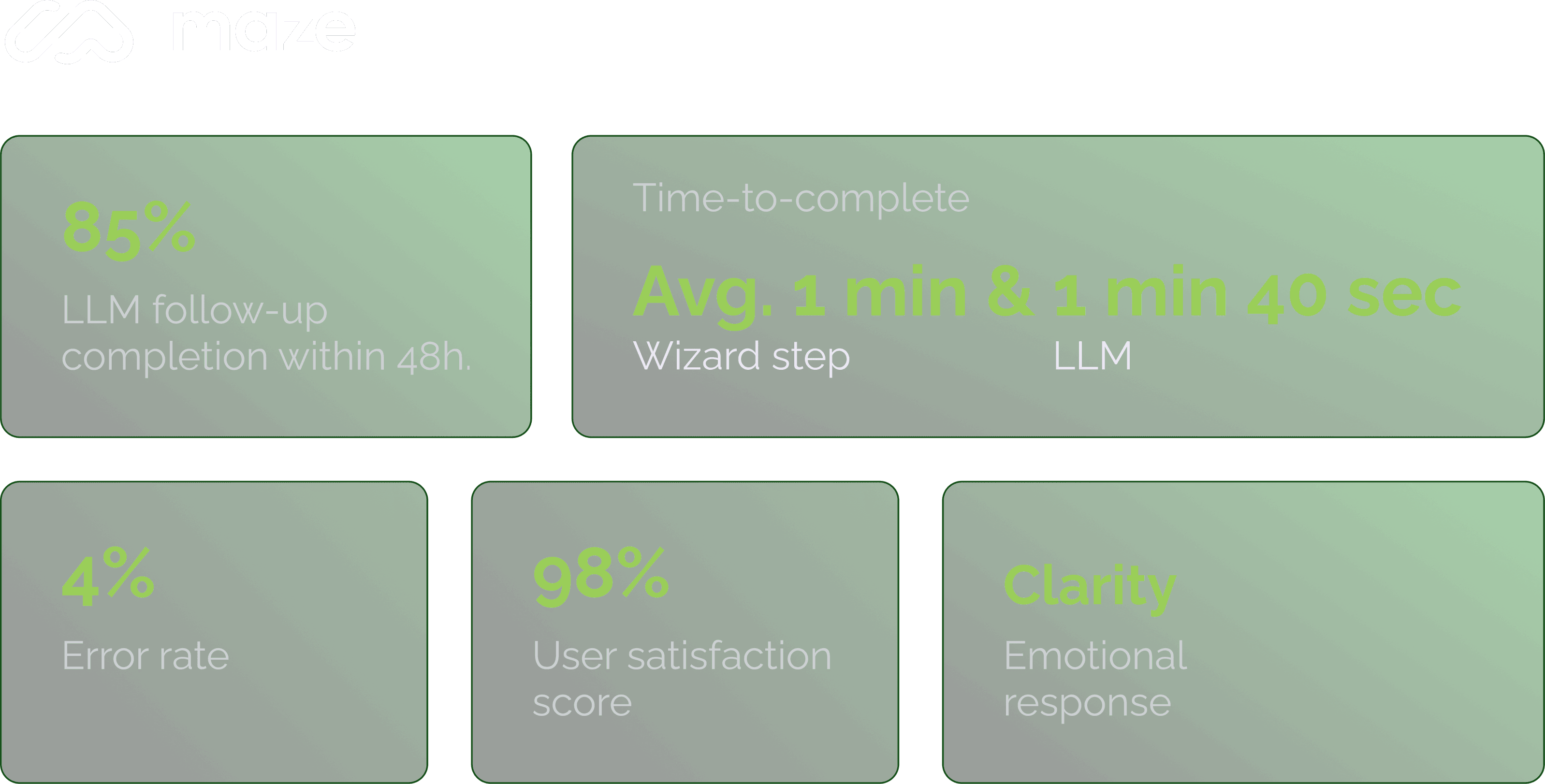
Continuous iteration & user testing using Maze and qualitative feedback
Hybrid onboarding systems (Wizard + LLM-based conversational onboarding)
Screen flow creation after the full design, to identify missing states and system gaps
Collaboration with developers (handoff, logic alignment, edge cases)
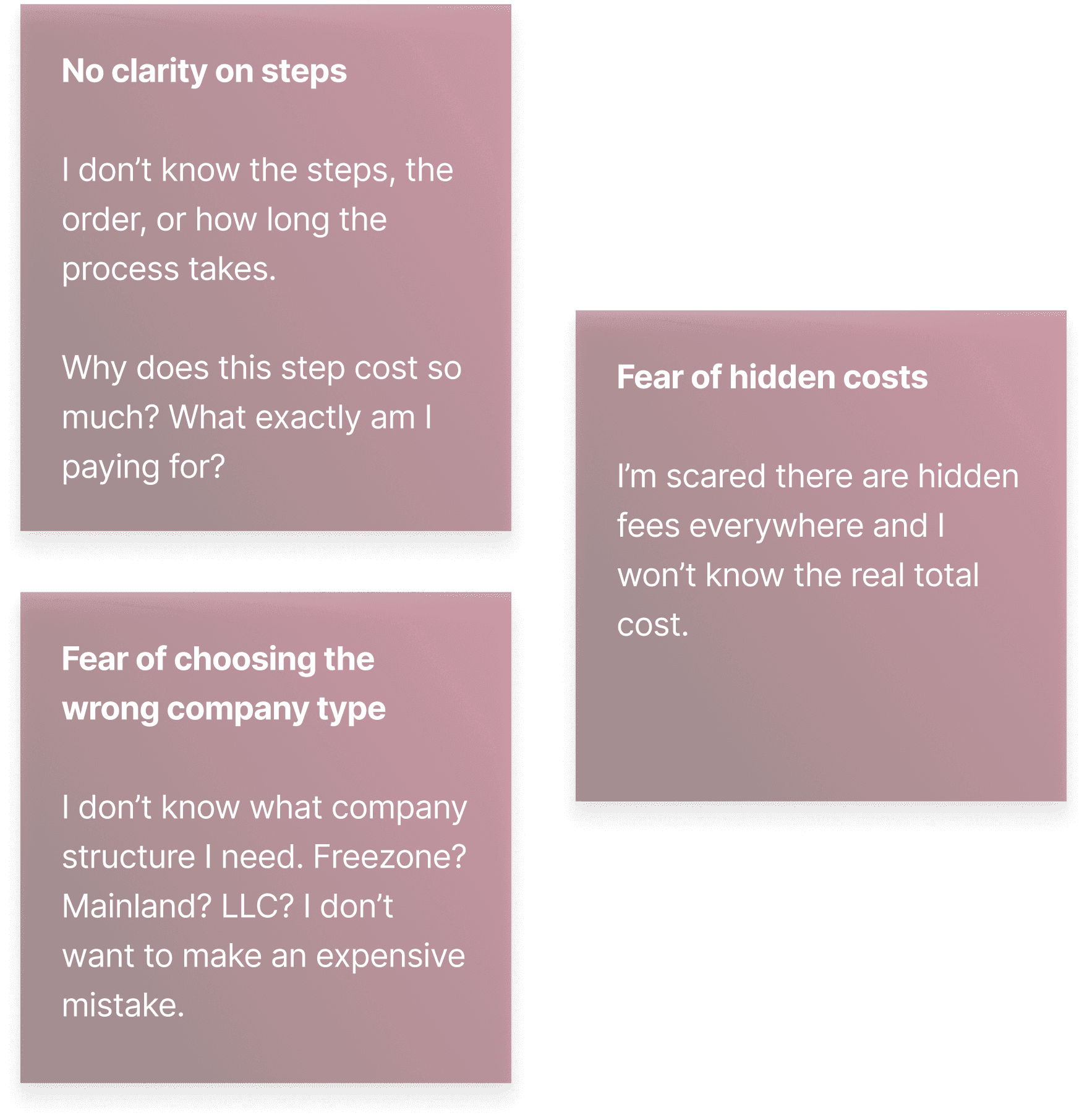
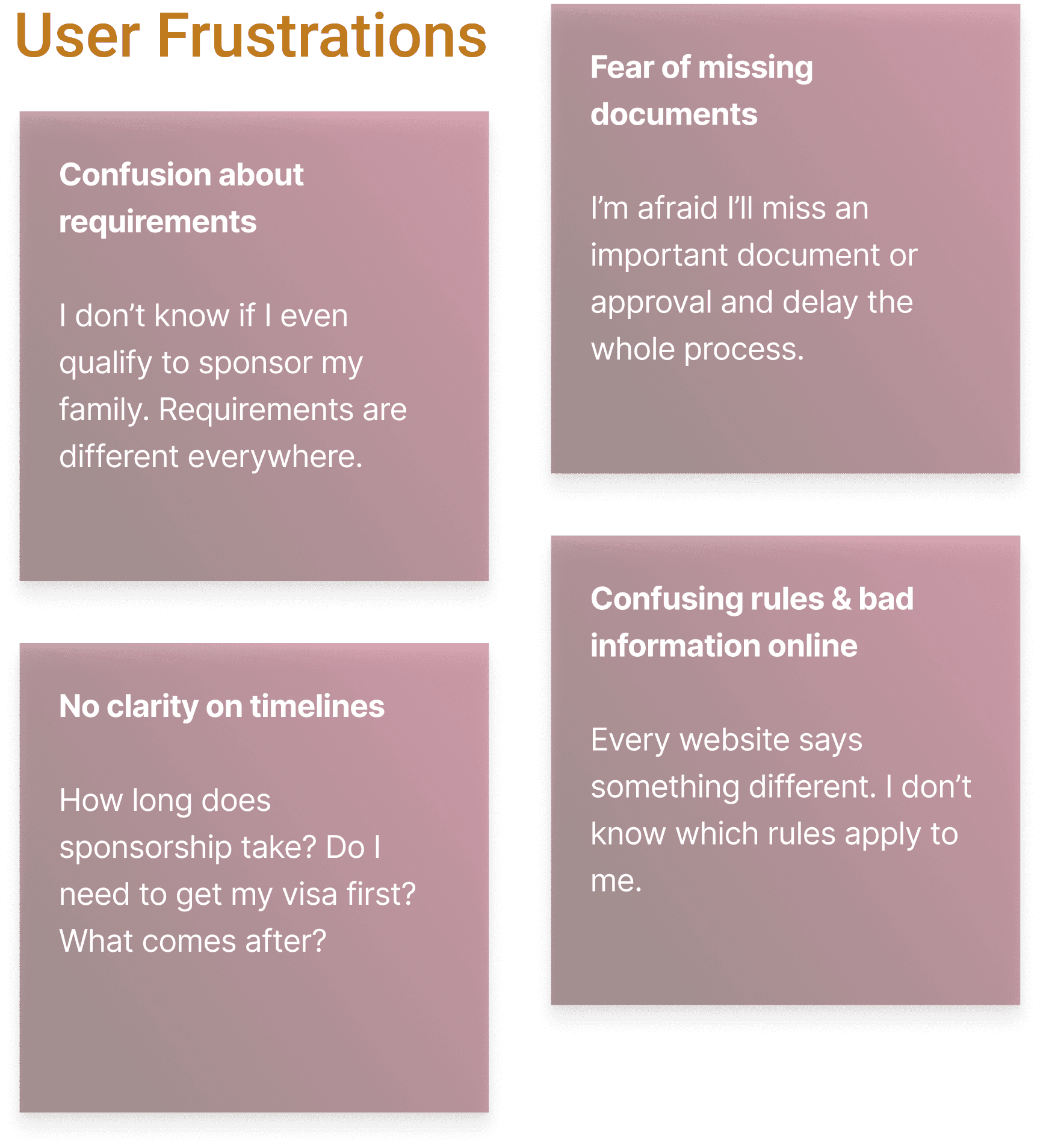
The Problems
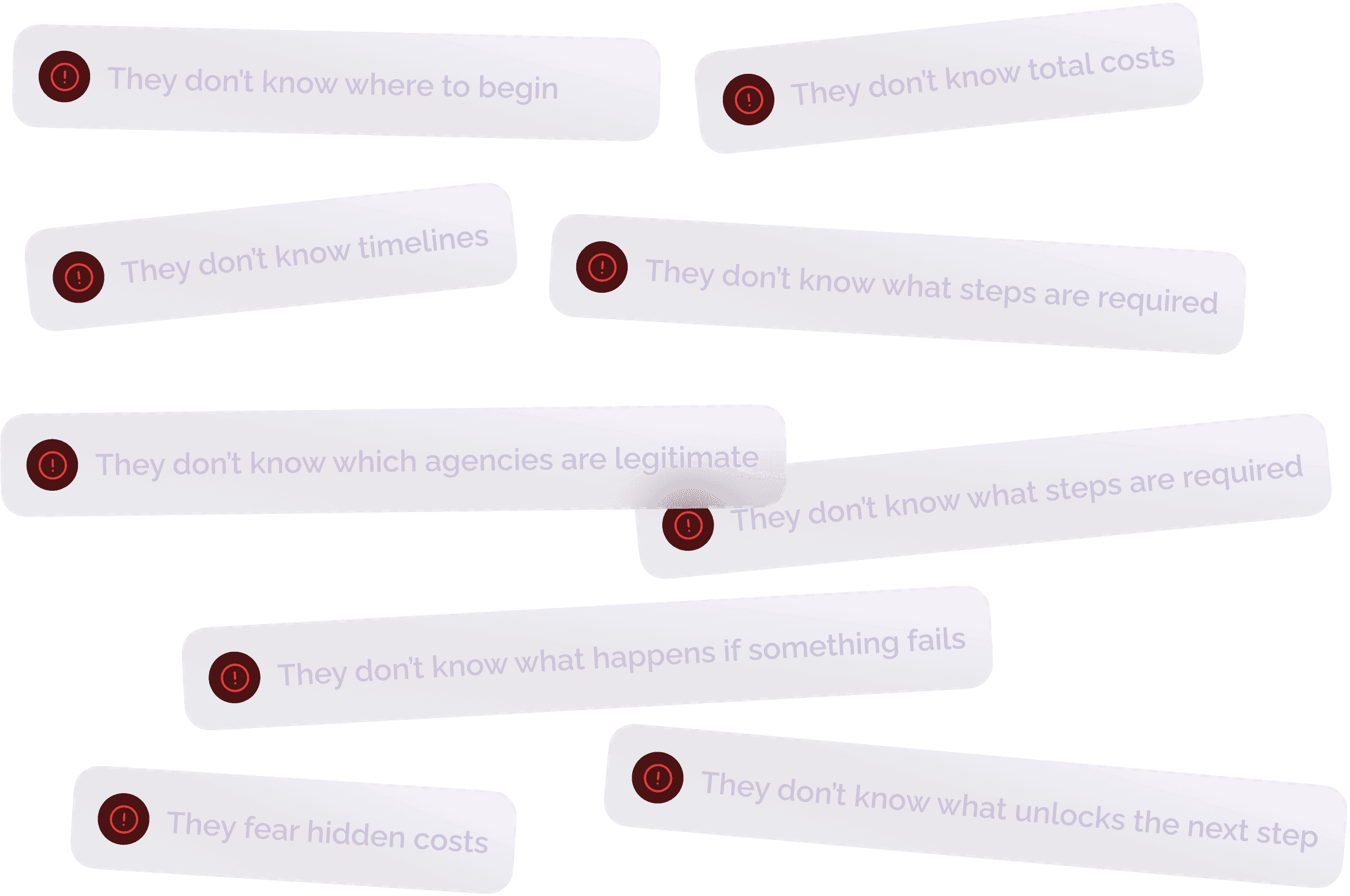
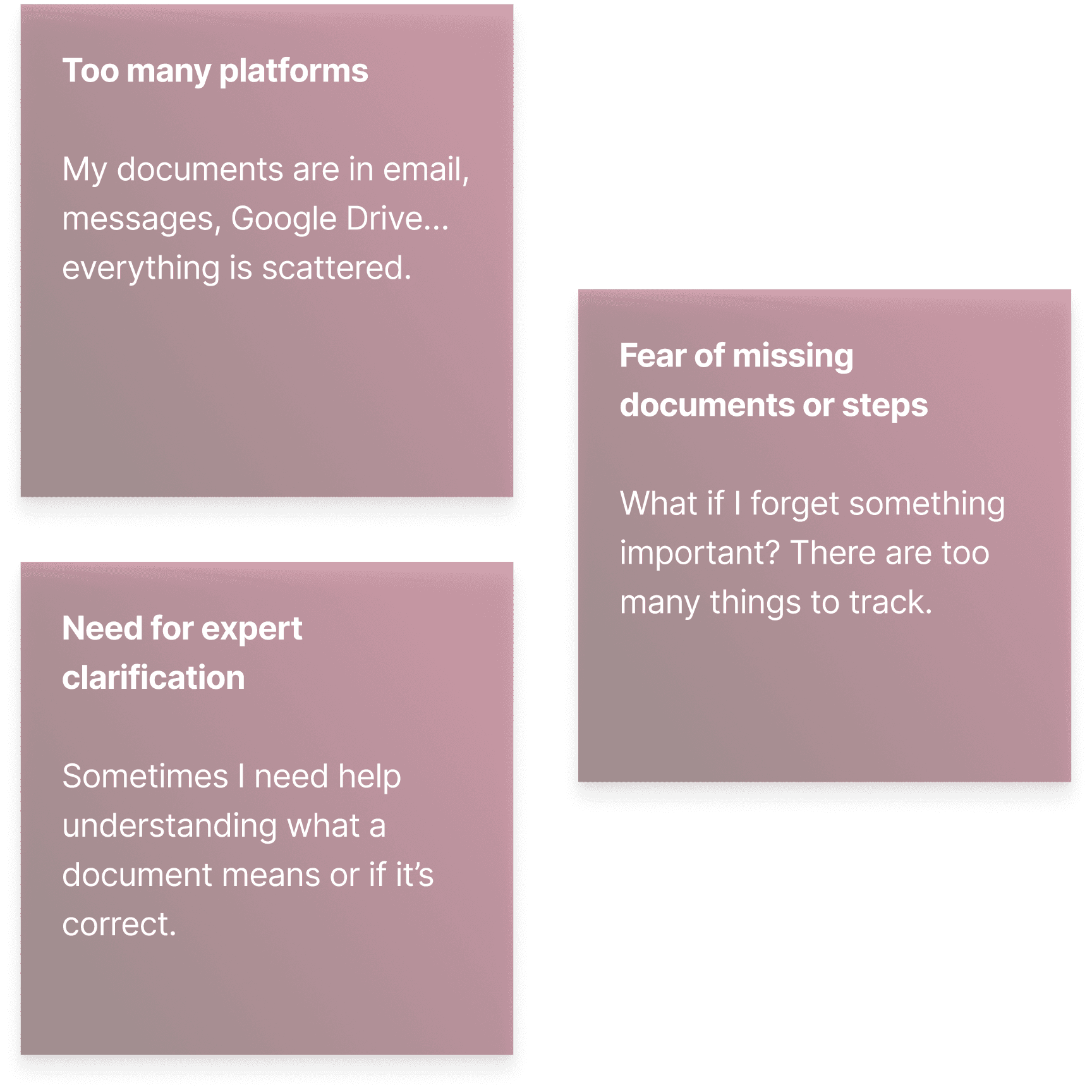
Relocation doesn’t fail because people lack motivation. It fails because of uncertainty and fragmentation.
Before even starting, users face:
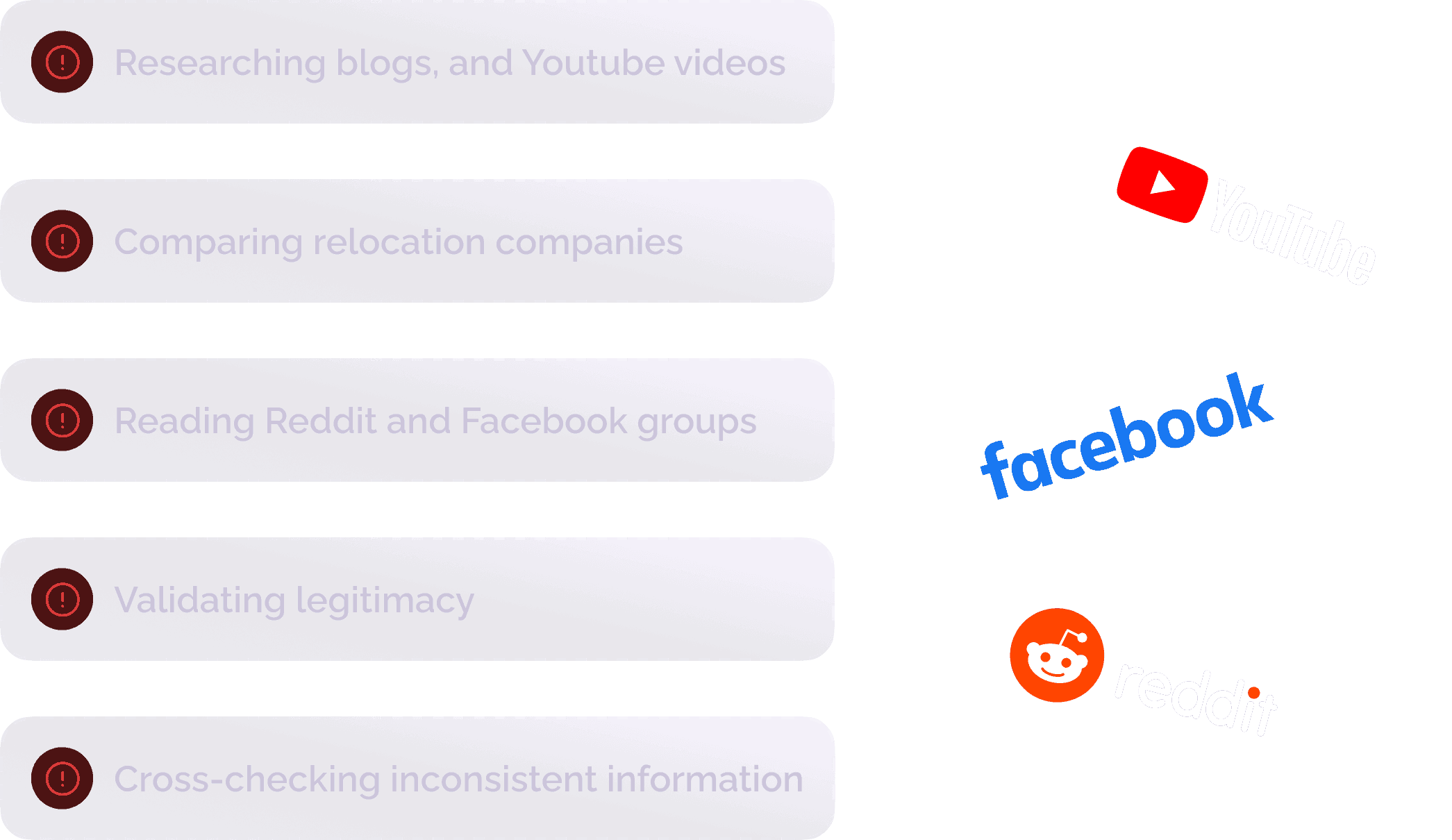
And before doing anything, they must spend weeks:


Research & Validation
Personal Relocation Experience: Real On-Site Research
Designing Orion wasn’t just a professional project for me, it was a real-life journey.
I founded my own company in Dubai, went through the entire relocation flow myself, and documented every single step:
legal requirements
dependent sponsorship
visas
company setup
contracts
budgeting
relocation fear
This gave me something no research method can match:
First-hand experience with the same fears, confusion, blockers, and decisions users face.
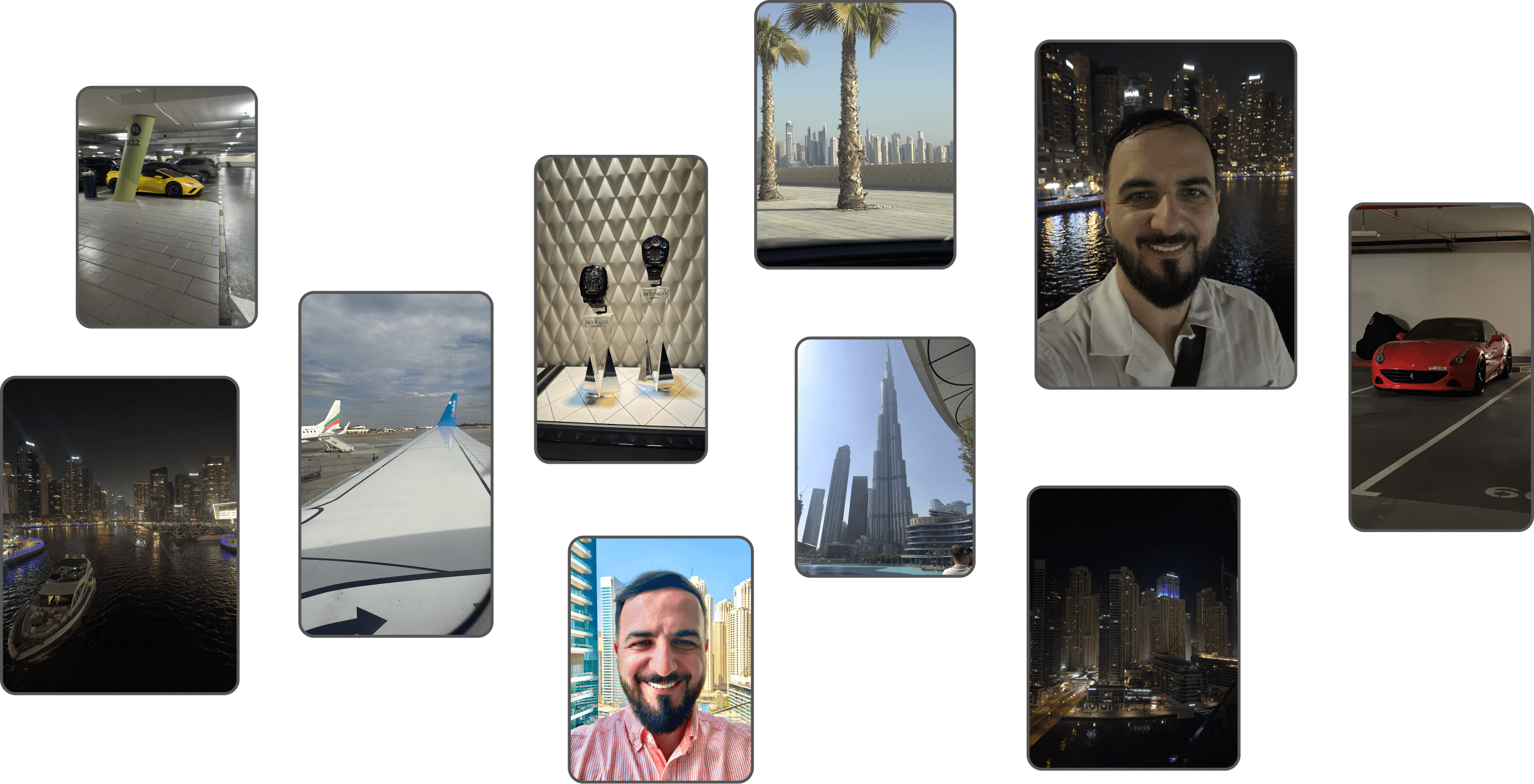
Why this mattered
I understood the flow from the inside, not just from external interviews.
I experienced the same frustrations users had: unclear processes, conflicting information, hidden costs.
I validated what people say online vs. what actually happens on the ground.
I identified blind spots that typical user interviews don’t reveal.
I documented the full timeline, costs, documents, and dependencies in detail.


To validate whether these were common patterns, I built an AI-powered research agent using:
N8N for automated data pipelines
Public social media crawling (posts, comments, groups)
Antigravity for FE & BE vibecoding the dashboard
Supabase for structured data storage
I wanted to deeply understand what people relocating to Dubai actually struggle with, not based on assumptions, but on large-scale real conversations happening online.
This allowed me to collect
Real frustrations
Real goals
Recurring patterns
Unmet needs
Emotional blockers
Misinformation areas
Service gaps
Expectations before and after relocation
I wanted to deeply understand what people relocating to Dubai actually struggle with, not based on assumptions, but on large-scale real conversations happening online.
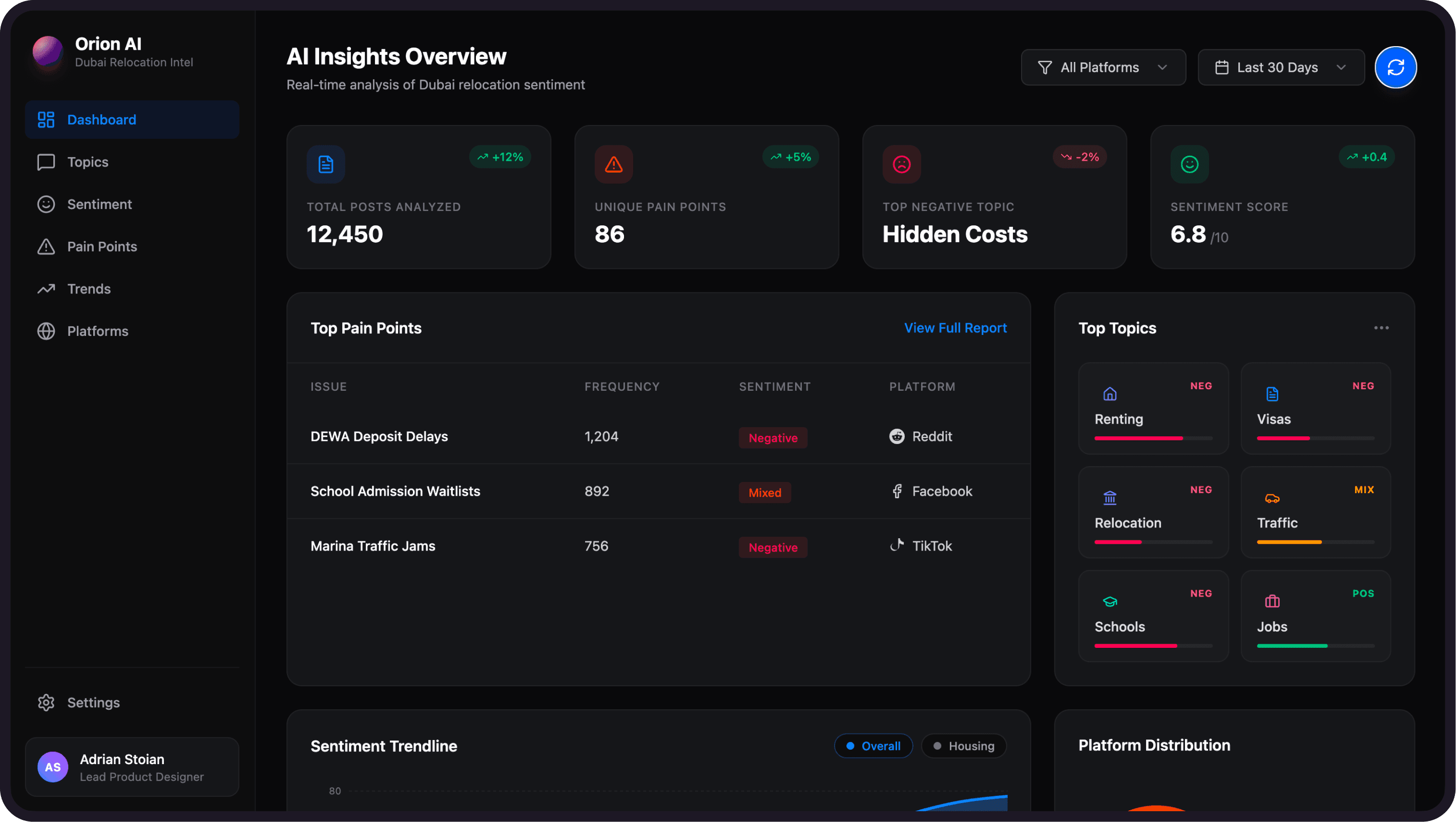
N8N - Technical Flow of the AI Agent
Scheduled Trigger
Runs every 3 hours

Data Scraping Nodes
Reddit API (subreddits: r/dubai, r/dubaiexpats, r/expats)
Facebook Graph API (public posts + comments)
TikTok Webhook/API
YouTube Search + Comment Threads API
Cleaning & Preprocessing Node
Remove noise (ads, duplicates, spam)
Normalize text
Chunk large posts into analyzable segments
AI Embedding & Classification (OpenAI Node)
Topic classification
Sentiment analysis
Intent detection (e.g., “renting”, “salary”, “visa”, “insurance”, “schools”)
Pain point extraction
Goal extraction
Red flags & warnings tagging
Aggregation Layer
Merge data into unified JSON schema
Group insights by recurring patterns
Database Save Node (Supabase)
Stores:
Parsed content
Topics & clusters
Sentiment scores
User goals
Pain points
Source platform
Notification + Forwarding
Sends all structured data into the Orion Insight Dashboard built with Antigravity.
Antigravity Dashboard
Visual charts of most common issues
Sentiment over time
Topic clusters
Real quotes from users
Frequency trendlines
“Rising concerns” detector
“Top misinformation topics”
Because of this system, I built Orion directly around what real people relocating to Dubai actually need:

Help choosing areas to live
Budgeting guidance
Visa steps
Opening company
Avoiding scams
Salary benchmarks
School selection
Healthcare navigation
Timelines & paperwork
What to do BEFORE flying
What mistakes to avoid

2025 Findings
~128,800
Public signals in 2025 indicating relocation interest toward Dubai
~67%
expressed hesitation due to financial uncertainty:
rising rental prices.
unclear visa/entry requirements.
unpredictable cost of living fluctuations.
lack of transparent budgeting tools.
~74%
Especially around:
visa fees
dependency visas
agency commissions
school admissions
one-time move-in costs (Ejari, deposits, DEWA).
~48%
explicitly requested trusted, verified relocation partners.
Confusion Around Company Setup, Visa Type & Hidden Costs
Users don’t understand which company structure they actually need (Freezone vs Mainland, LLC vs Sole Establishment).
High fear of choosing the wrong setup and losing money due to hidden renewal fees or restrictions.
Heavy confusion around visa types (employment, investor, freelance, dependent).
Many underestimated total costs by 30–60 days and thousands of dirhams.
Strong negative sentiment around scams, unverifiable agencies, and inconsistent government information.
Visa Processes Are Confusing and Poorly Explained
High volume of questions about visa types (family, investor, employment).
Users confused by changing rules, outdated YouTube/TikTok advice, and conflicting guidance.
Common request: “I wish someone explained everything step-by-step without jargon.”
Heavy Fear of Scams & Overpaying
Many newcomers feel vulnerable and report:
“Hidden fees”
“Deposit not returned”
“Fake listings”
“Paid twice by mistake”.
High distrust toward cheap agencies, random relocation “consultants”, and online listings.
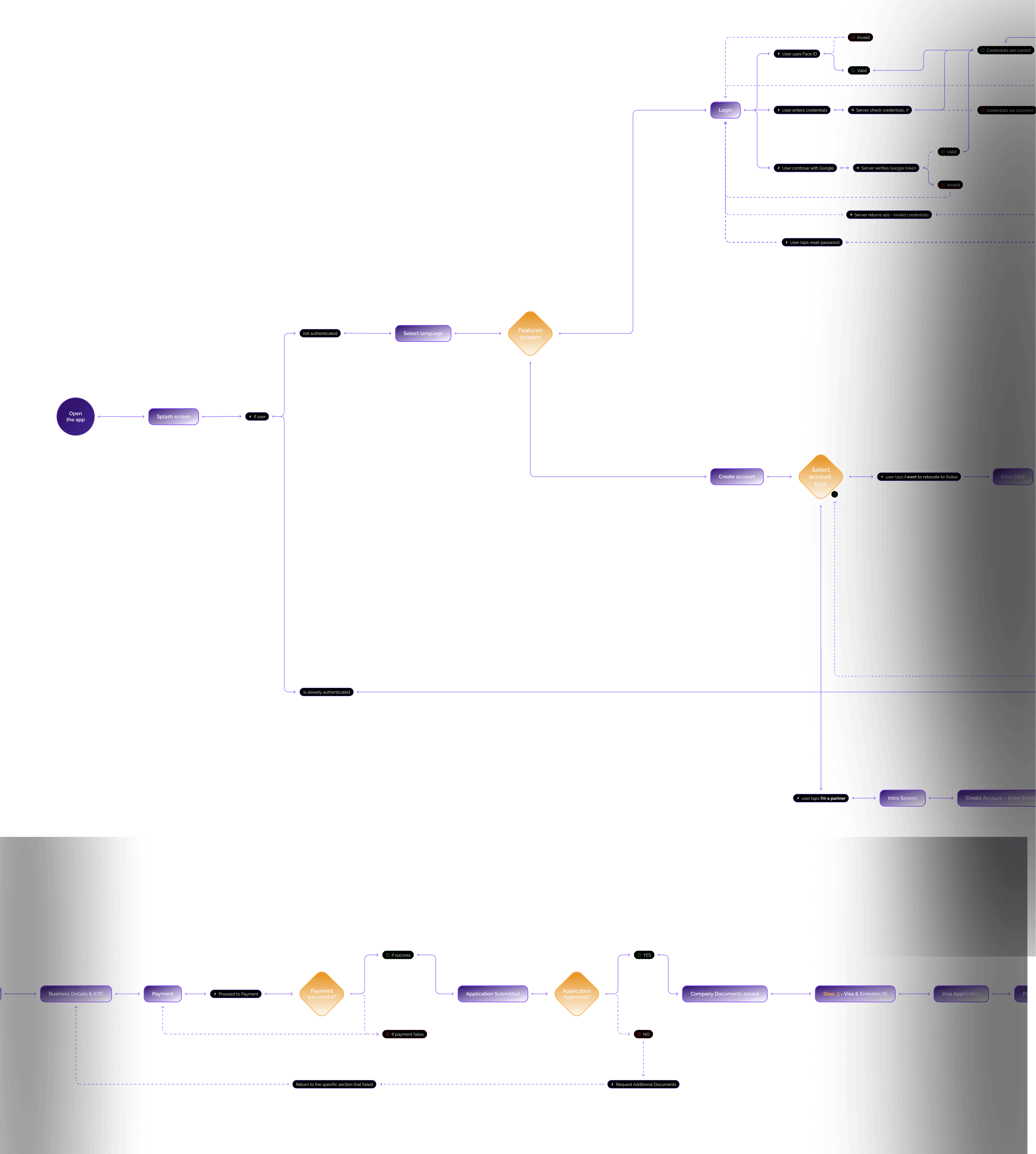
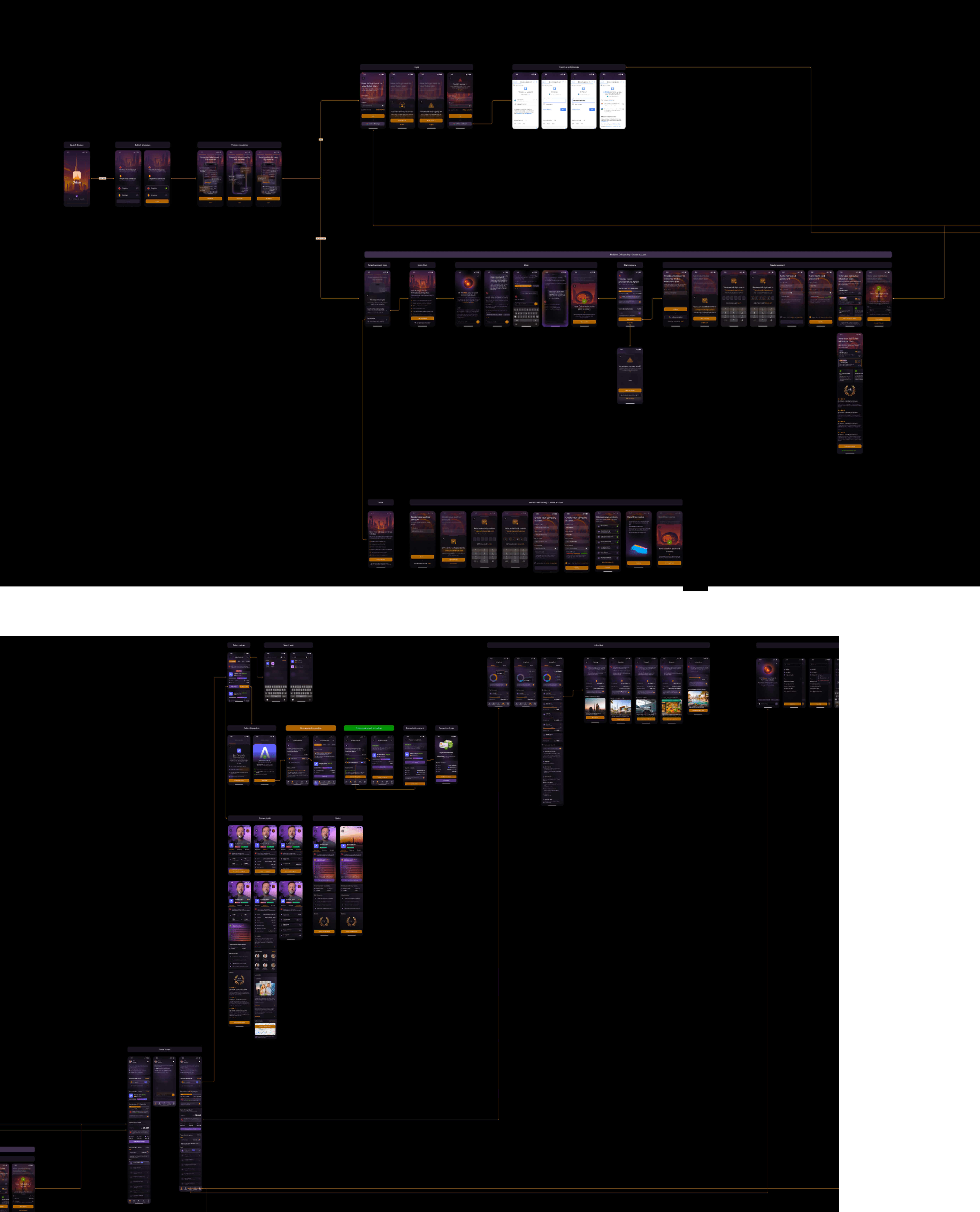
User flow of the entire app
Why this step was crucial?
To translate chaotic real-world needs into a clear, guided product path
To identify all modules, dependencies, and cross-flows early
To prevent feature overlap and redundancy
To define the “happy path”, “support path”, and “recovery paths”
To support developers, PMs, and business stakeholders with clarity
To help estimate timelines and development complexity
To align future AI features with real user actions
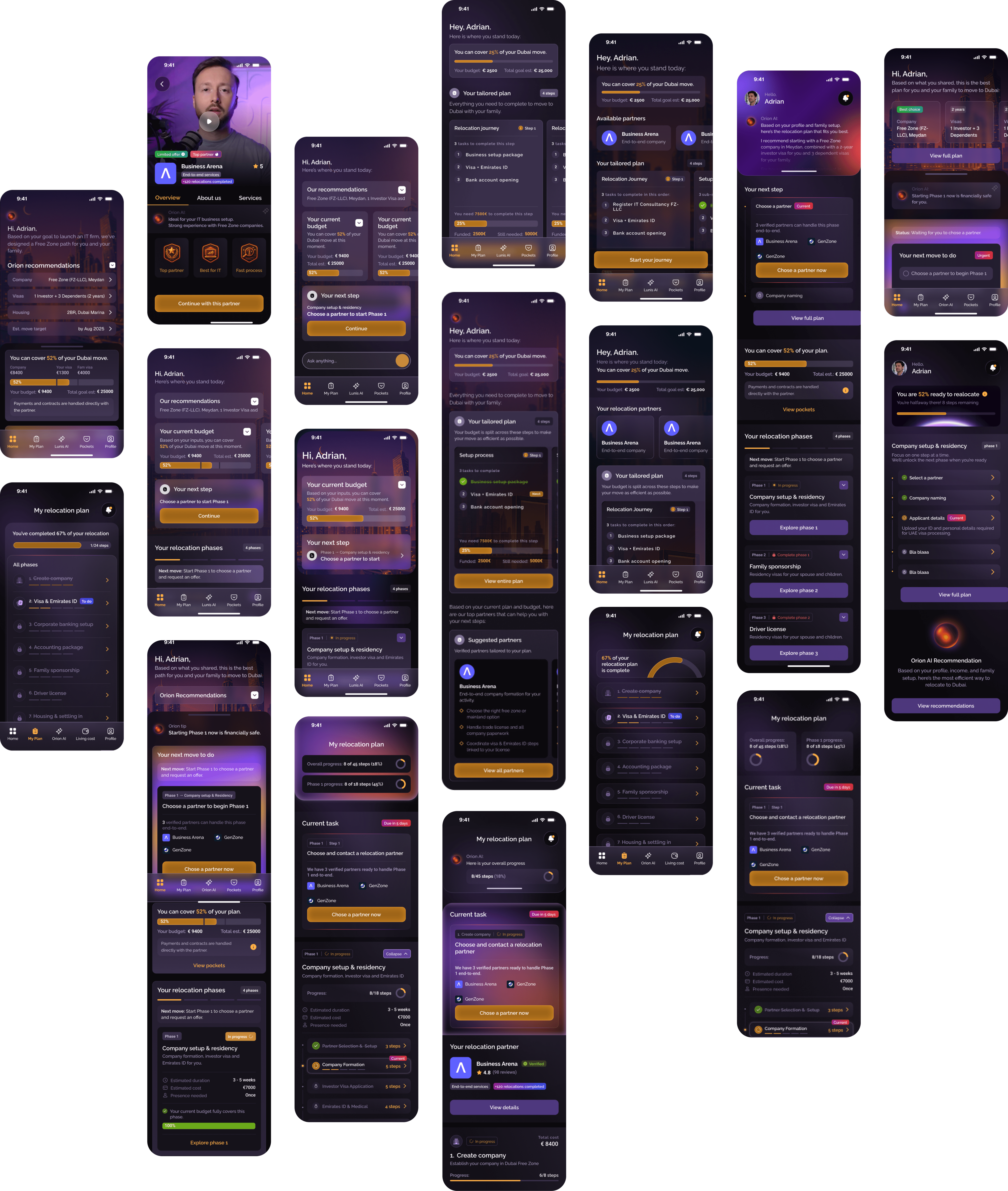
Exploring Onboarding, Account Creation & Personalized Relocation Plan for residents.
To design the onboarding and plan-generation experience, I explored two distinct approaches:
1
A classic multi-step wizard
2
A conversational, AI-driven onboarding powered by an LLM agent.
Version 1
Classic Multi-Step Wizard
Traditional-UX
Initially, I designed a conventional step-based wizard consisting of multiple sequential screens where the user needed to input personal details, relocation intentions, budget, visa type, and family information.
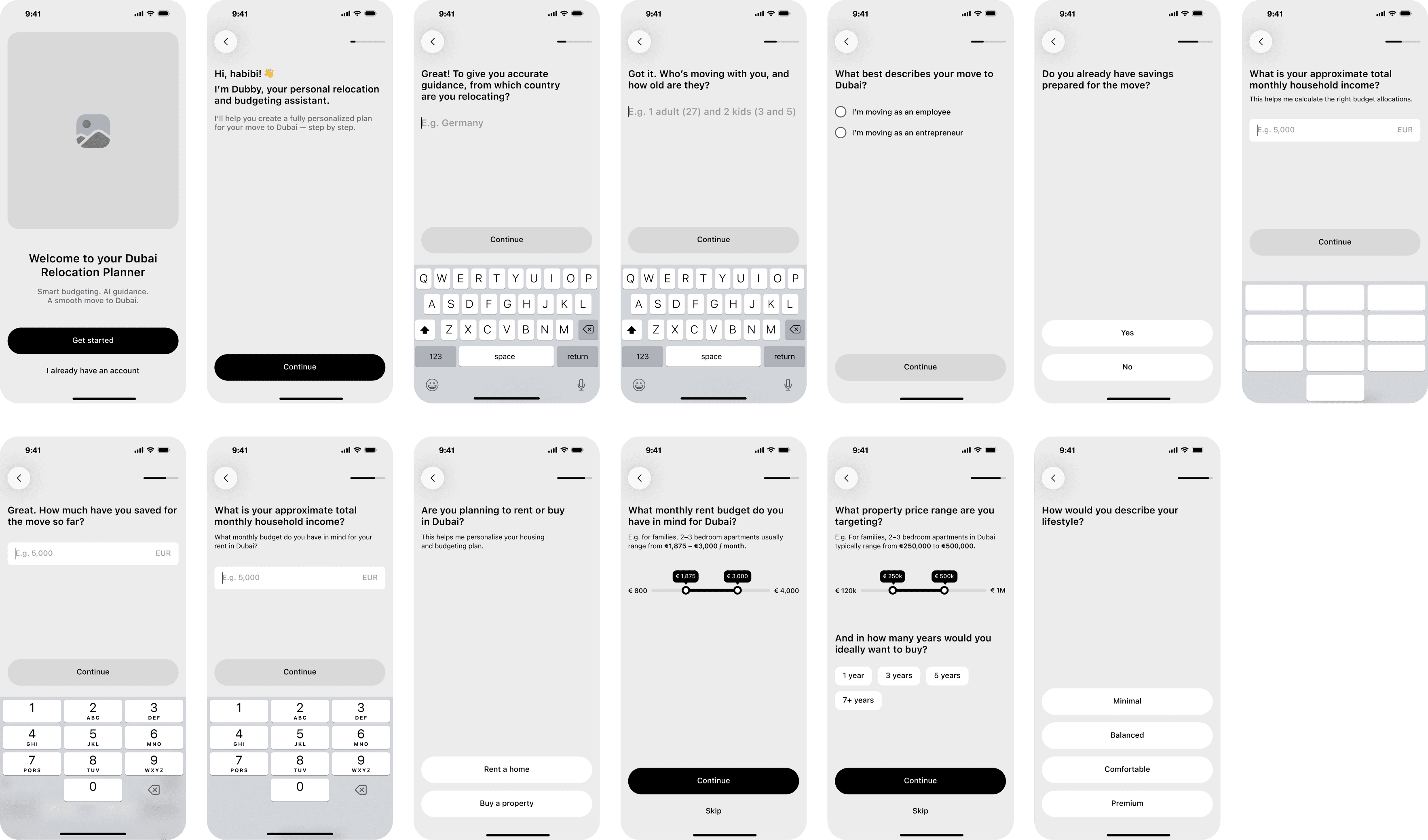
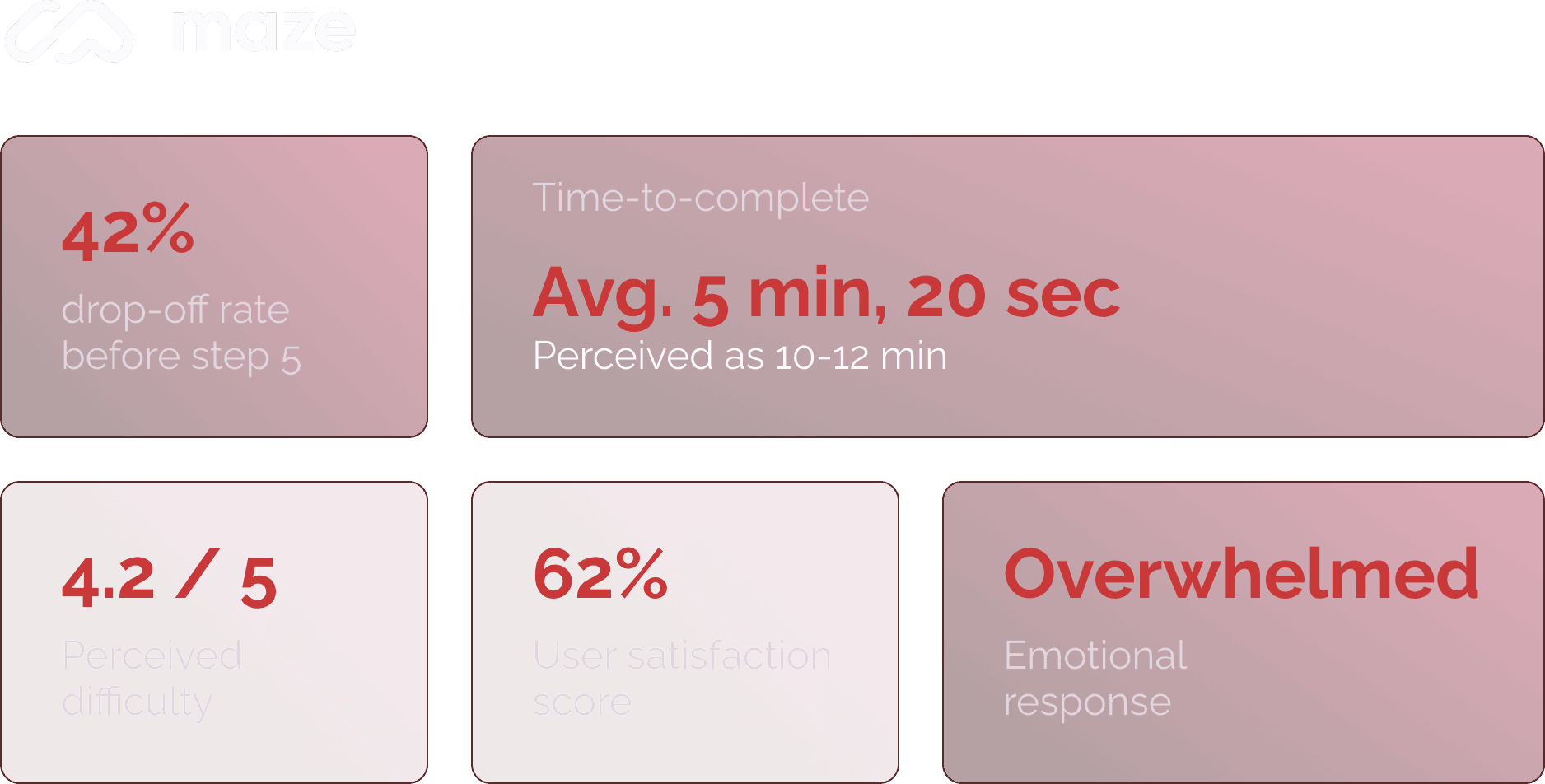
Although the steps were not objectively many, the perceived effort was significantly higher.
What User Testing Revealed
Users felt the process was long, even though it wasn’t.
They described the flow as “too much”, “tiring”, and “overwhelming”.
The constant switching between screens increased cognitive load.
The format felt rigid and “form-like”, reducing motivation.

Version 2
AI-Powered Conversational Onboarding
LLM Agent
I then explored an alternative approach: A natural-language, conversational onboarding powered by an AI Agent (LLM), which guides the user through relaxed dialogue, similar to ChatGPT, which users already trust and interact with daily.
2
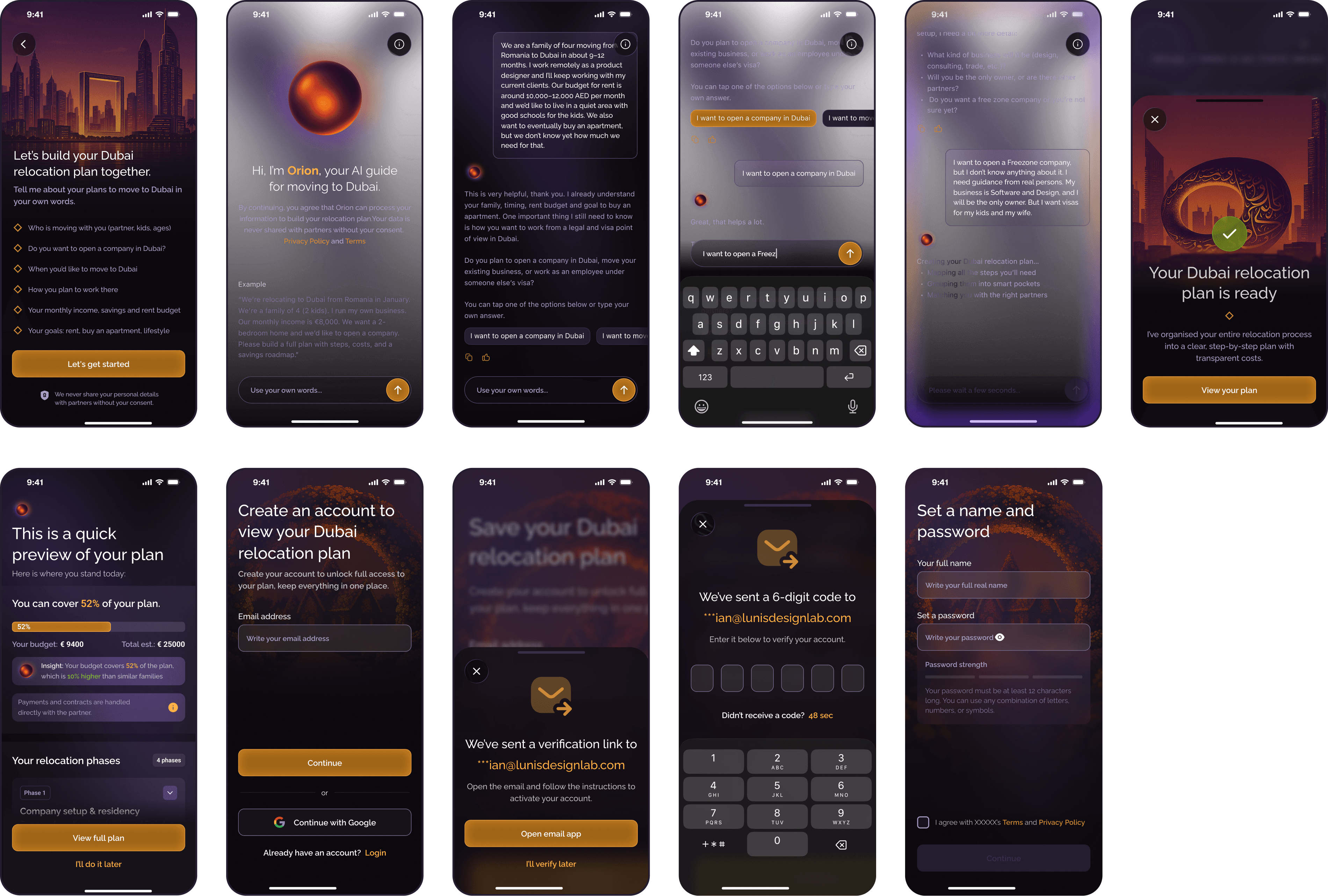
Why this worked?
Low cognitive friction.
Natural, friendly, human-like interaction.
Felt personal and supportive, not bureaucratic.
Captured more precise information with less perceived effort.
Users felt they were “talking to someone who understands Dubai”

Designing the app
Home Screen + Partner Selection + Budget View
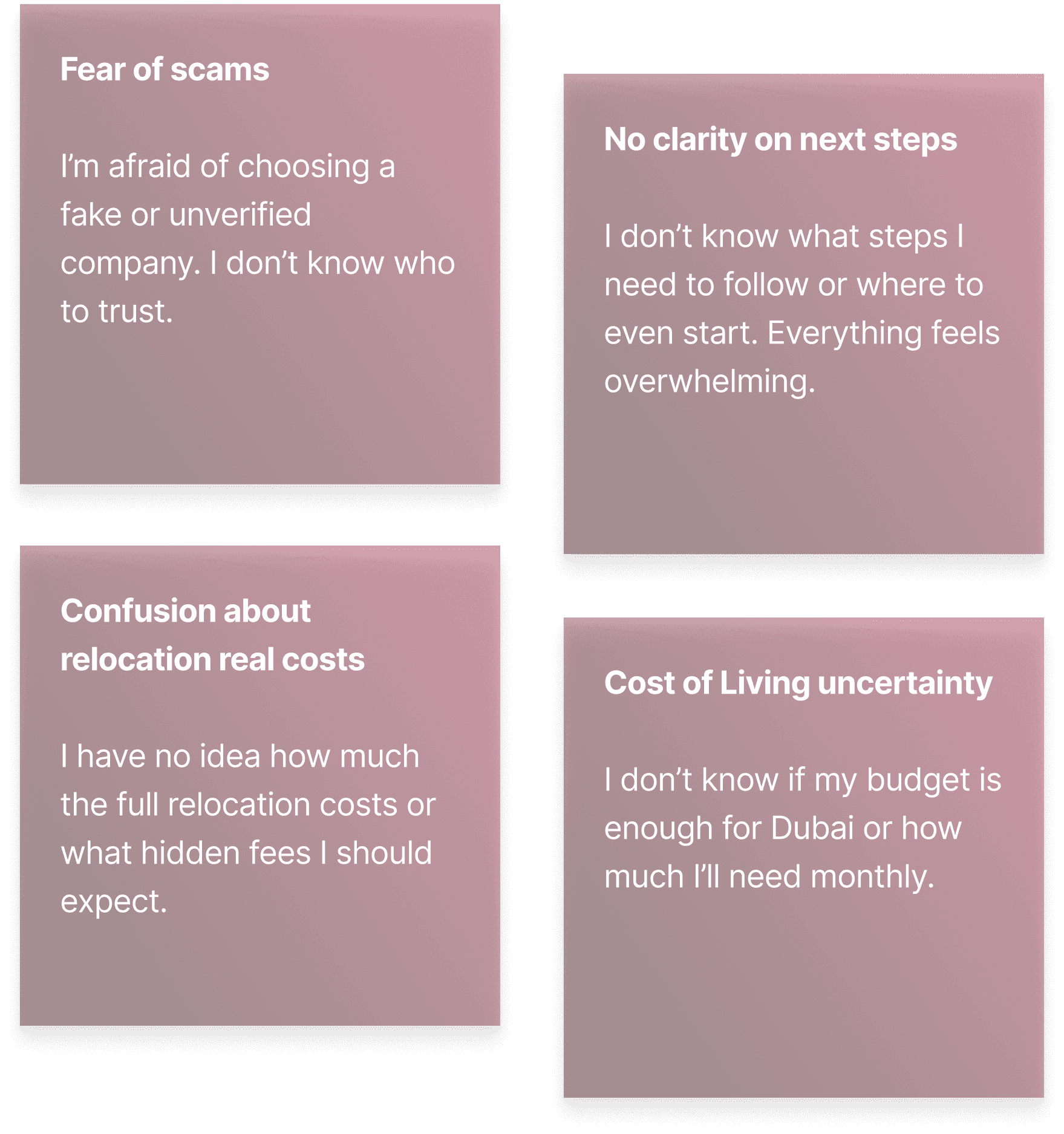
How I solved these critical fears
To eliminate uncertainty from the very first moment, I redesigned the Home experience as a transparent, guided control center for the entire relocation.
Their next step, with live status and a clear call to action.
Total relocation cost, fully calculated, no hidden fees.
How much of that cost their current budget covers.
Dubai cost-of-living estimate tailored to their profile.
Verified relocation partners they can choose from as the very first step.
Trust signals & transparency on each partner’s page (documents, reputation, ratings, services included).
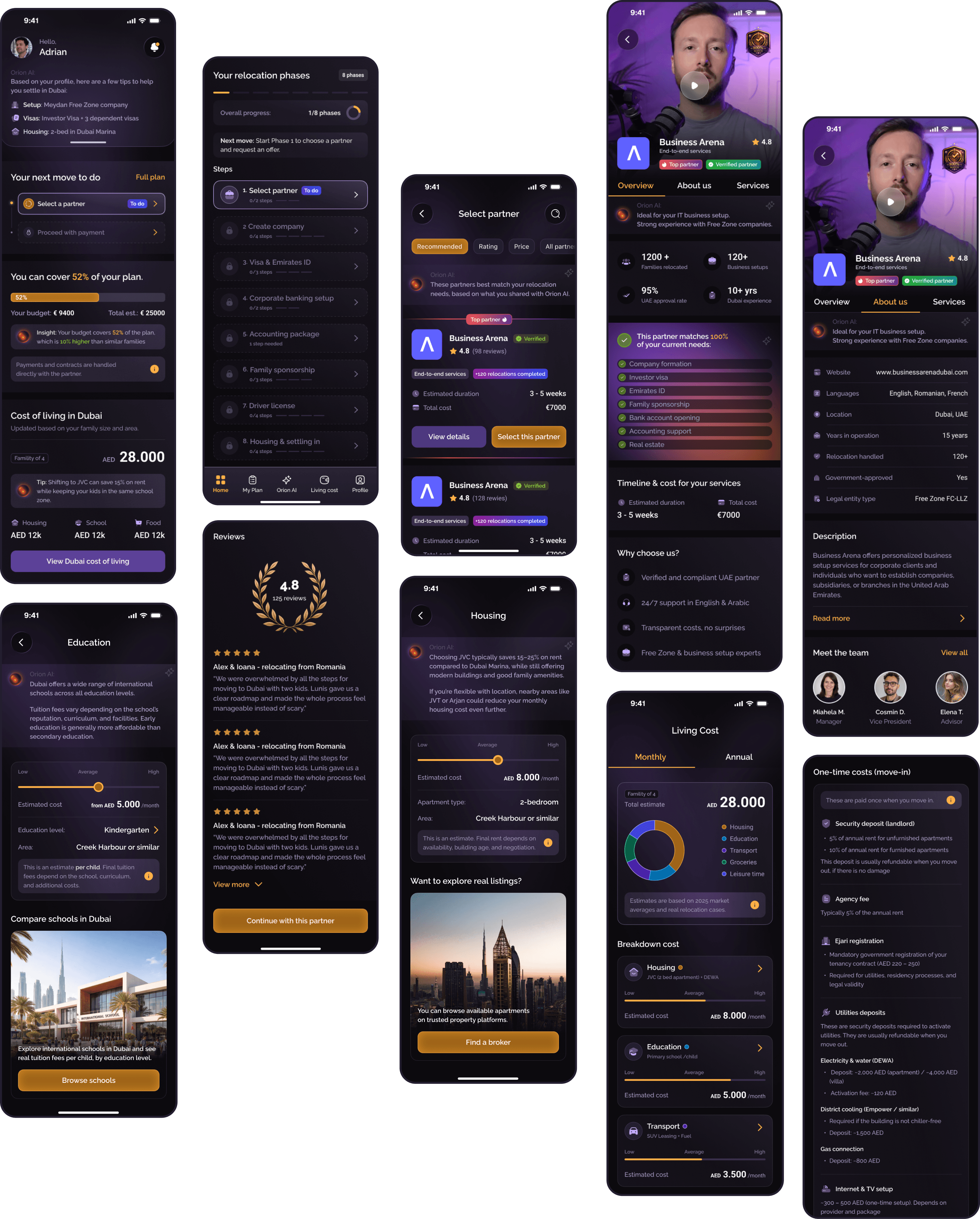

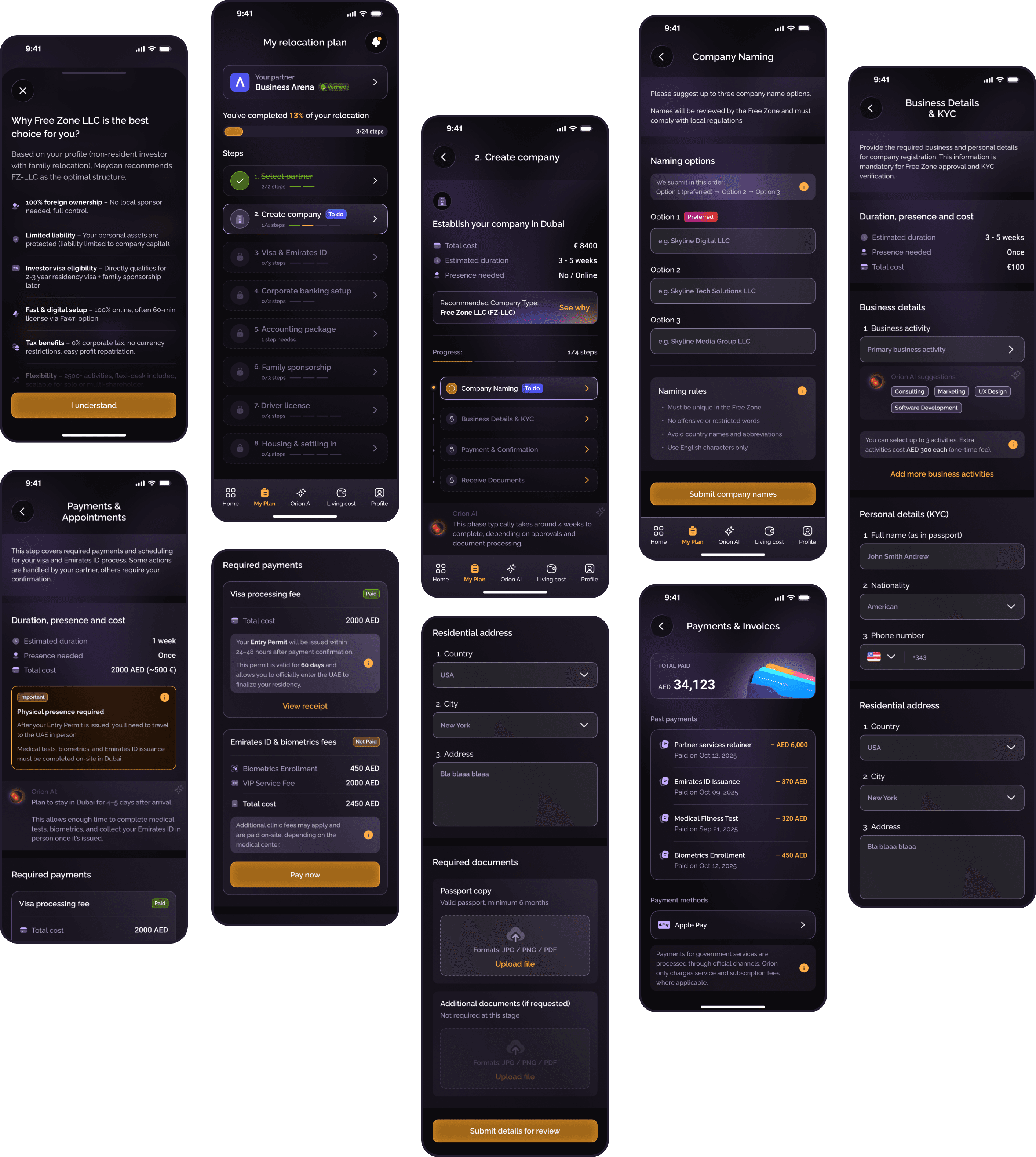
Next, I solved the confusion around the relocation process by breaking everything into clear phases, each with structured steps, full transparency, and AI guidance.

Phases & Steps
How I solved process confusion
I structured the entire relocation journey into clear phases, each containing transparent, easy-to-follow steps. Every step includes cost breakdowns, timelines, required documents, dependencies, risks, and AI insights to help users make confident decisions.
Each phase clearly shows:
Where the user is
What comes next
How long each step takes
What documents are required
What the exact cost is
What dependencies exist
And where AI can guide or optimize the decision
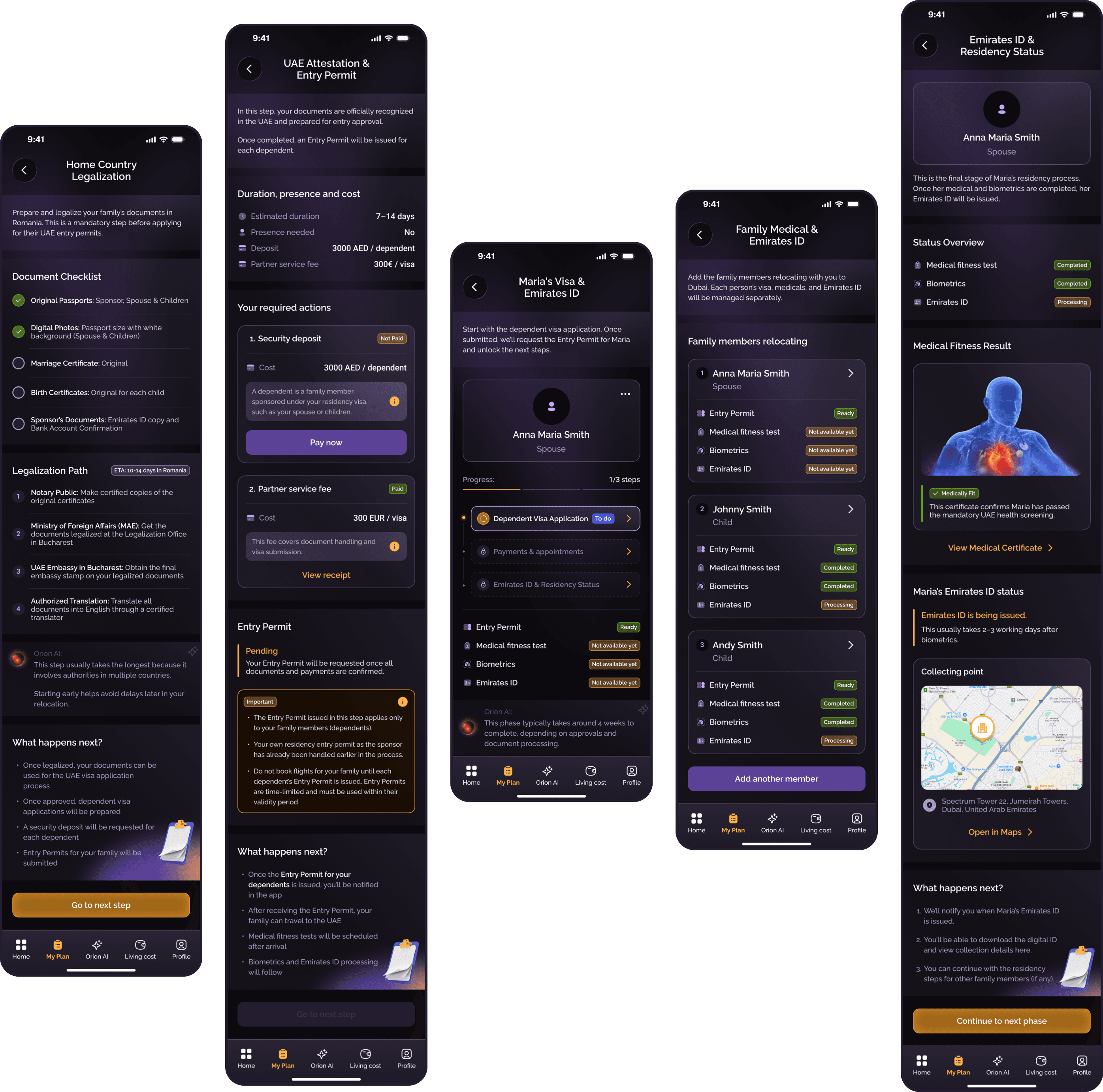
Family Sponsorship
How I solved process confusion
Family sponsorship in Dubai is one of the most stressful parts of relocation, so I designed a guided, AI-assisted flow that removes uncertainty and gives users clear, personalized instructions from start to finish.
Simple eligibility explanation based on the user’s profile
Exact documents required for each dependent
Transparent timeline with all dependencies
AI guidance for timing, rules, and potential delays
Real cost breakdown (visa, medical, Emirates ID, insurance)
A structured checklist that replaces confusion with clarity


AI, Chat & Documents
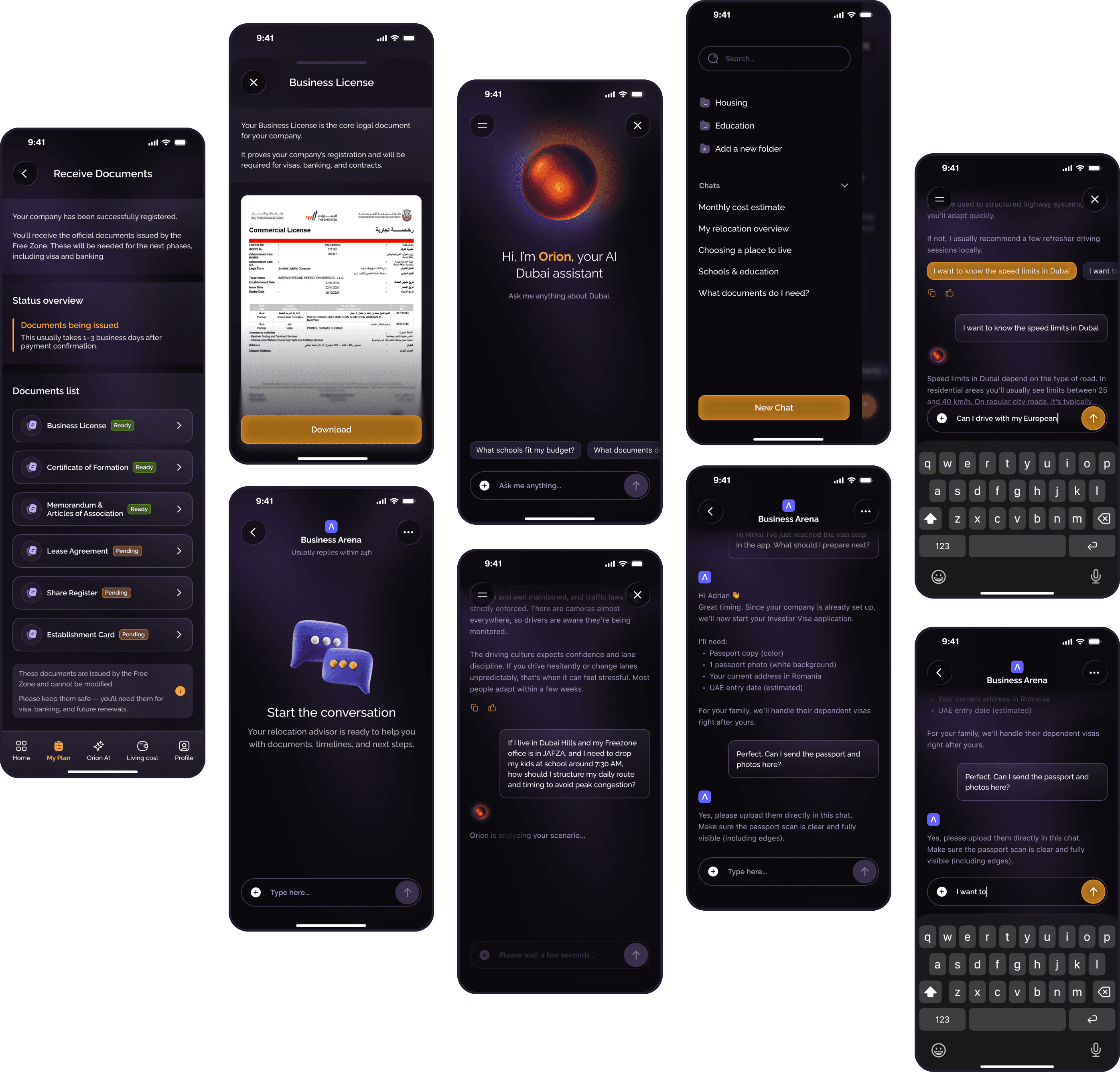
How I solved process confusion
To reduce stress and centralize the entire relocation, I created a secure workspace where users can manage documents, chat directly with their verified relocation partner, and get immediate support from the Orion AI Assistant.
All documents stored safely, encrypted, and easy to access
Direct communication with verified partners in one place (no WhatsApp, no guesswork)
AI reviews document requirements and explains what each file is for
AI answers questions instantly, reducing dependency on agents’ availability
Everything stays organized inside one secure environment
Partner module
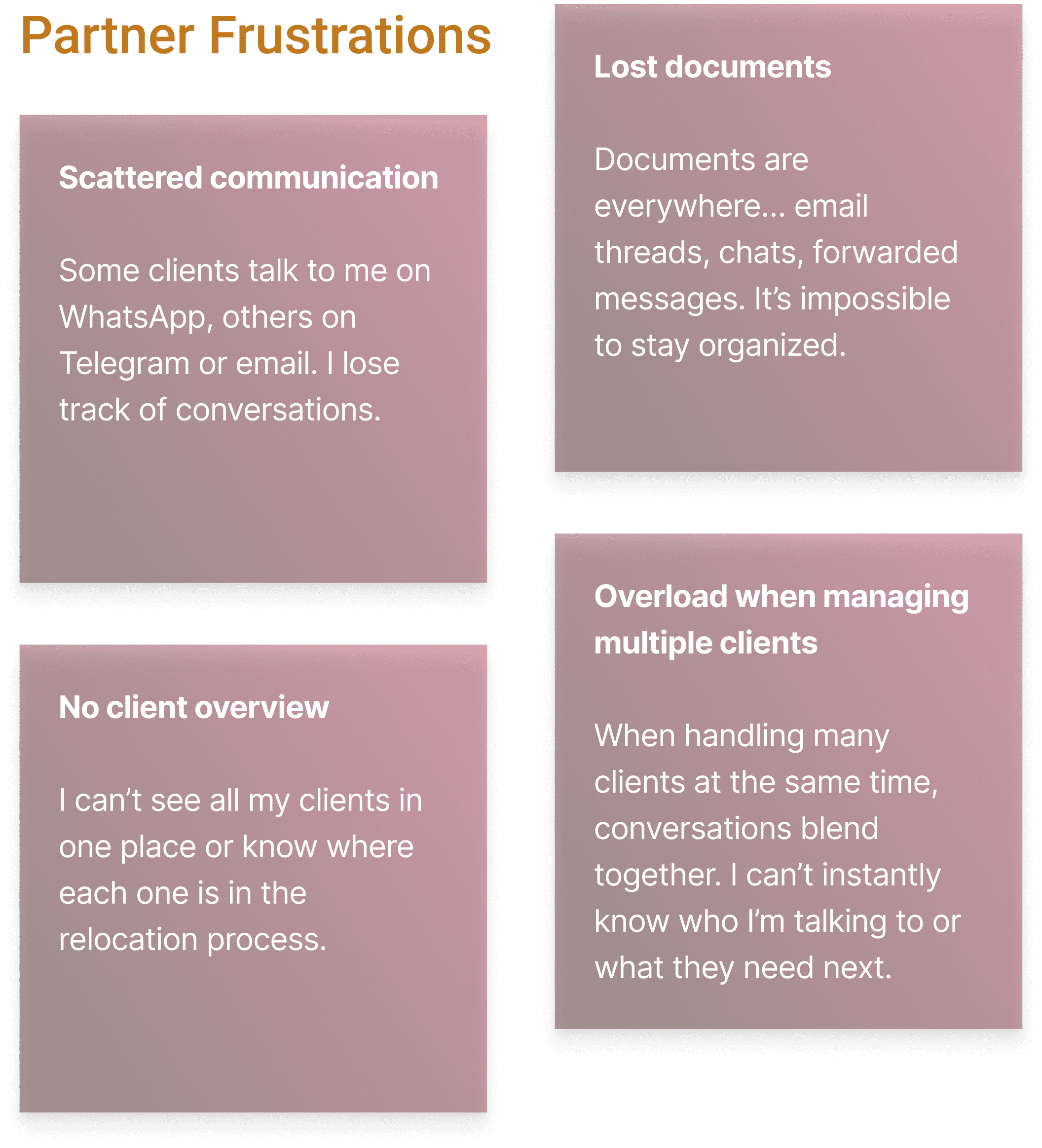
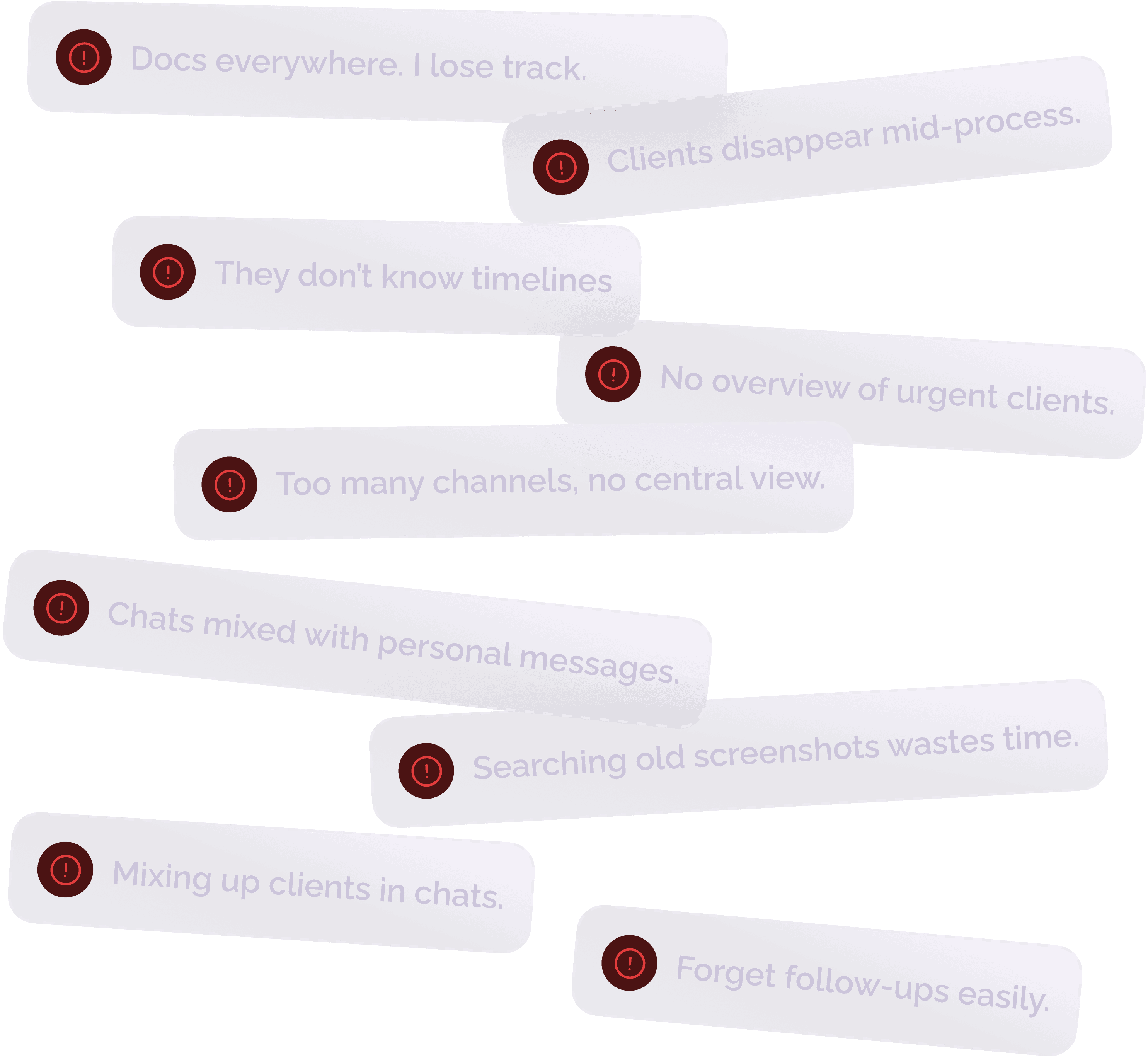
A streamlined hub where partners onboard smoothly, manage clients, keep documents organized, and track progress in real time. All without channel chaos. It centralizes everything they need to guide clients efficiently through the relocation process.

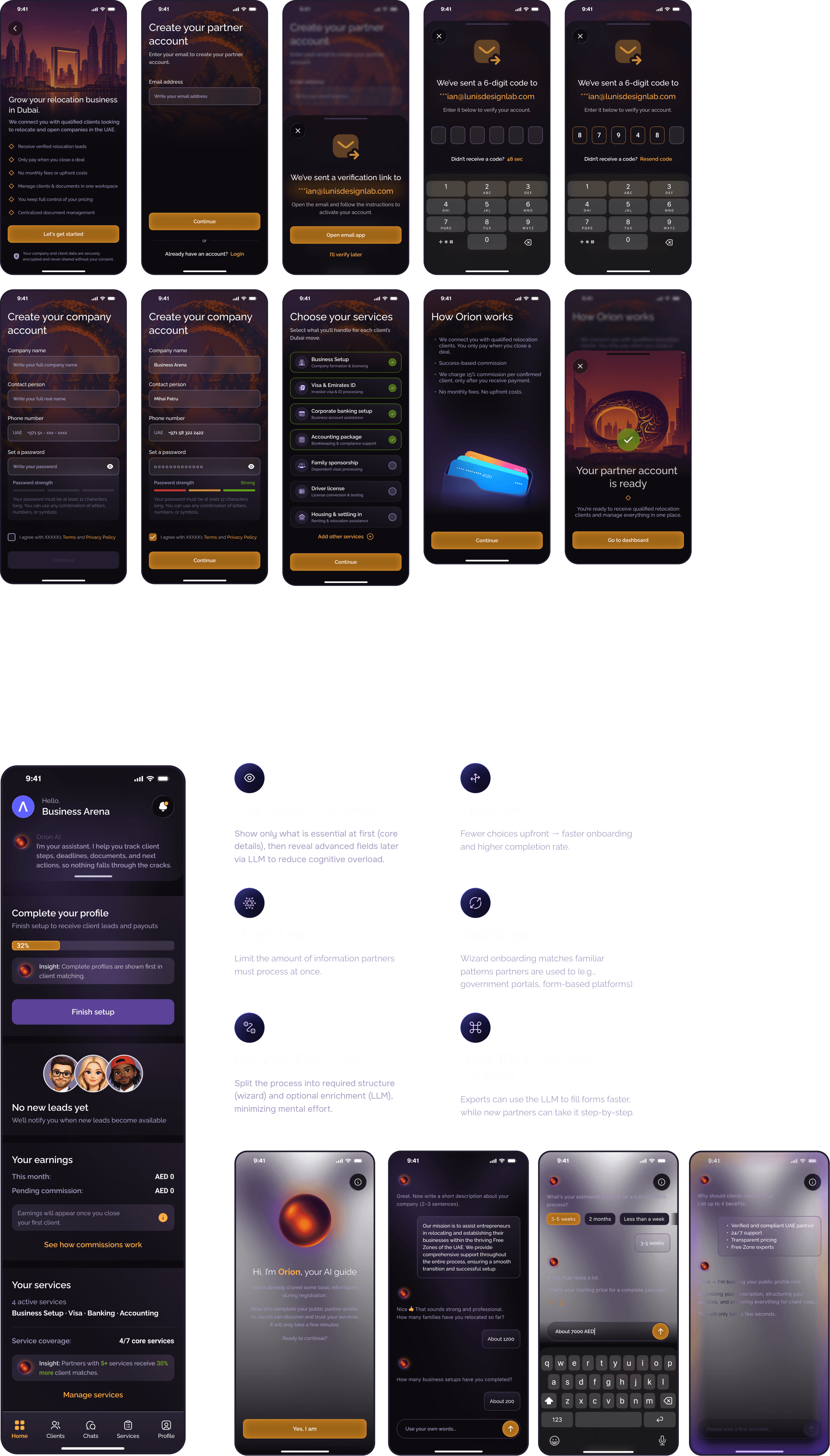
Wizard step + LLM Agent
Partner onboarding: structured, simple, and AI-augmented
I designed a hybrid onboarding flow: a short, structured wizard for the essential, verified details, followed by an LLM assistant that lets partners complete and enrich their profile later, directly from the home screen and at their own pace.
This hybrid approach kept the data consistent across the platform and prevented partners from creating duplicate or inconsistent services.
The wizard provided the structure and control they’re used to, while the LLM offered a natural, time-friendly way to complete the rest later. Since partners already use LLMs daily, the conversational flow felt intuitive, and the AI captured all remaining service, pricing, and business details, keeping the database clean and scalable.

Why this worked?
All documents stored safely, encrypted, and easy to access
Direct communication with verified partners in one place (no WhatsApp, no guesswork)
AI reviews document requirements and explains what each file is for
AI answers questions instantly, reducing dependency on agents’ availability
Everything stays organized inside one secure environment
Intelligent Partner Workspace
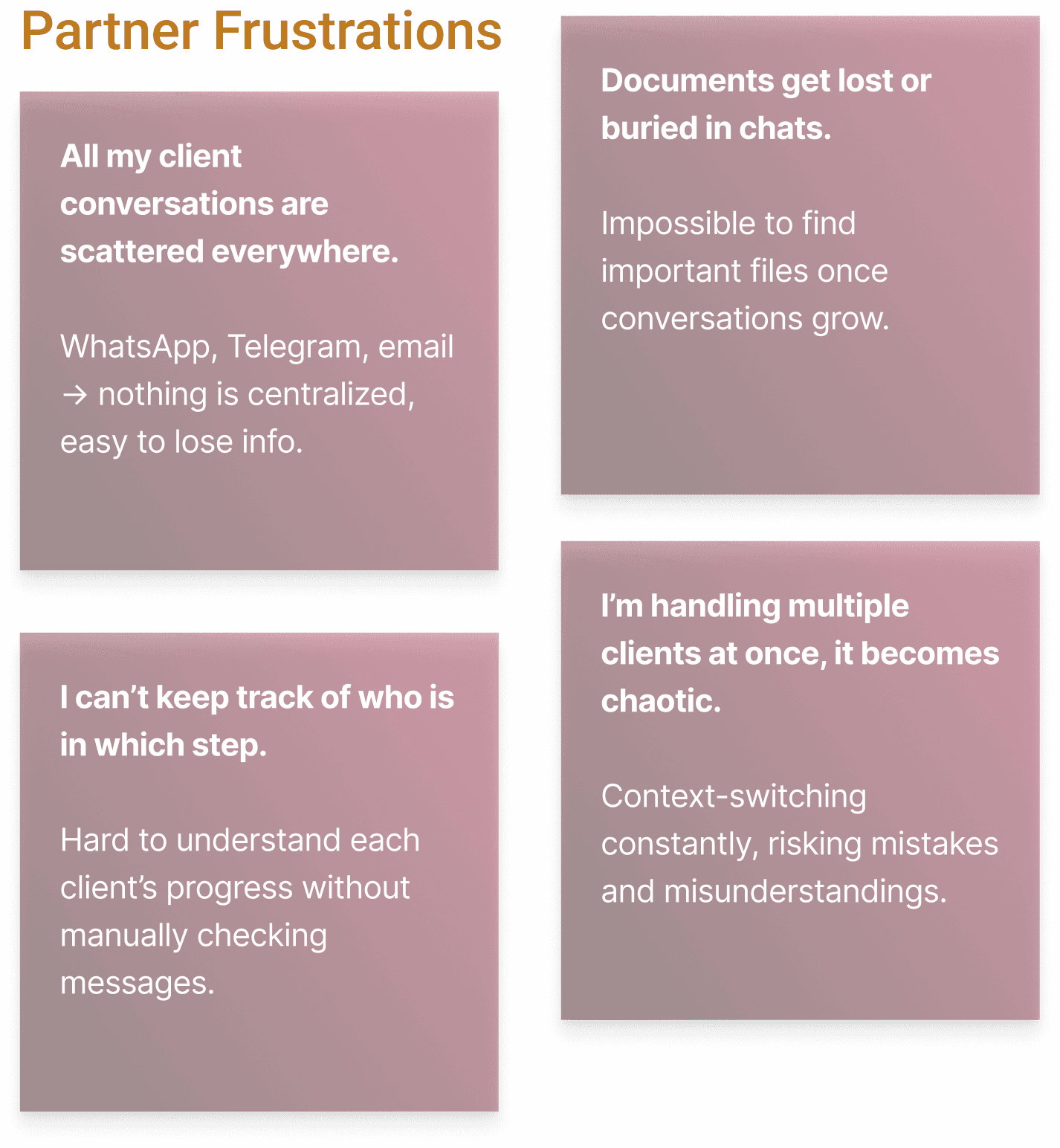
How I solved it
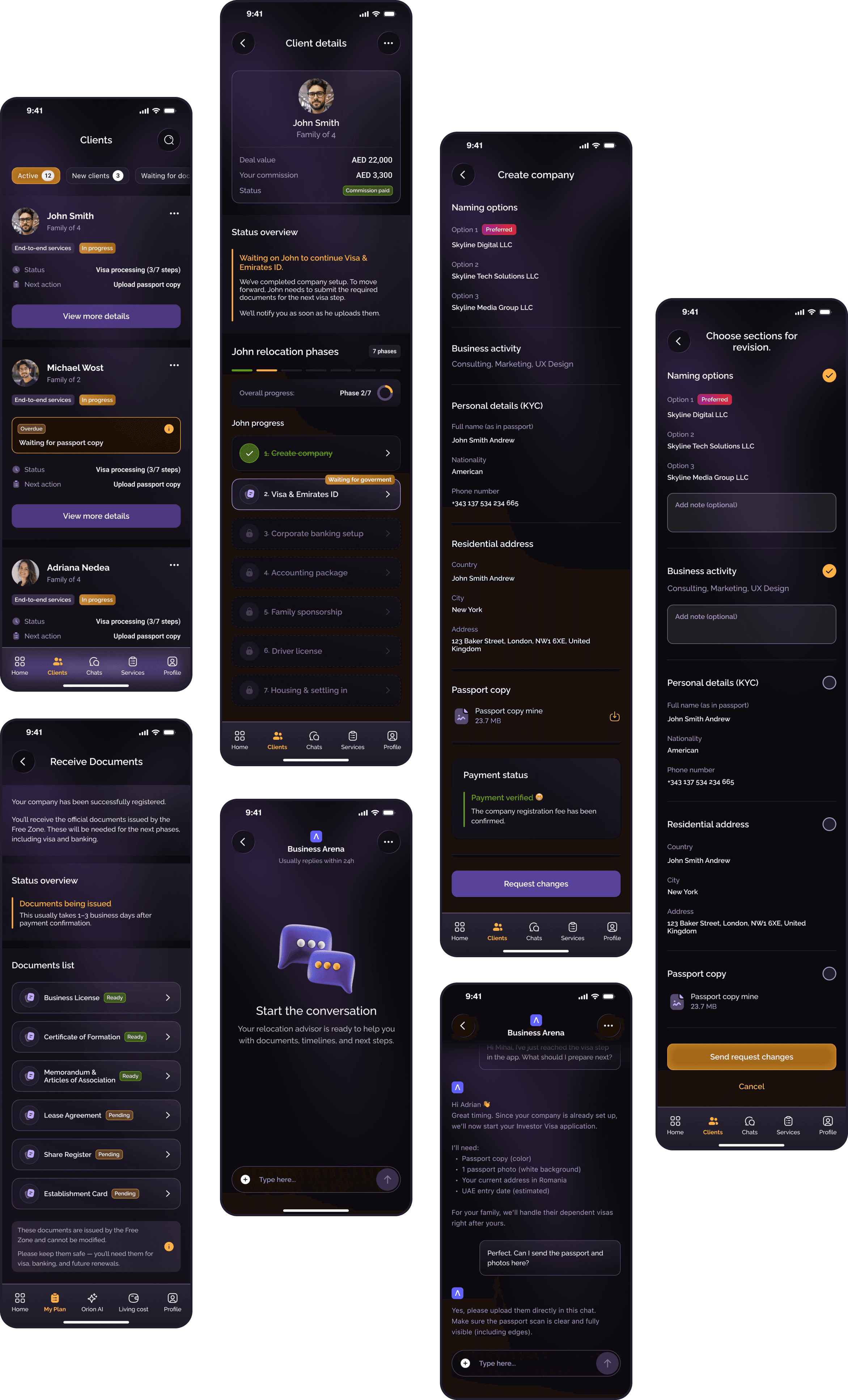
A single, centralized hub for the entire partner workflow.
What I designed?
Unified communication center
All messages with clients live inside the platform, no more multi-channel confusion.
Client timeline + real-time progress tracker
Partners instantly see each client’s current step, pending actions, and next requirements.
Structured document vault
Every file is tied to the correct client and step, with no risk of losing documents in chats.
Activity history for each client
Every message, file, and update is logged automatically.
AI-powered assistance
AI summarizes conversations, flags missing documents, suggests next steps, and helps partners reply faster.

Screen Flow
Full Application Screen Flow
Once all core screens were designed, I built a complete end-to-end screen flow to understand how every module connected, identify missing states, detect friction points, and ensure the entire system behaved as one coherent product.
This step revealed structural gaps that weren’t visible when looking at individual screens.
Missing states (empty, error, loading, success, fallback)
Edge cases not covered in early designs
Misaligned terminology across flows
Areas where the user needed more guidance or context
Logic mismatches between modules
Orion is now in active development.
After completing the full UX architecture, flows, UI, and AI logic, I transitioned into a close collaboration phase with the engineering team to support implementation.
The app is now being implemented by the engineering team using React Native Expo, allowing us to release both iOS and Android versions from a single, efficient codebase.